Ethics and Values
Strategy and Performance Management
Learning Objectives
After this section, you should have a solid understanding of
- what ethics, business ethics and corporate social responsibility is, including their key components;
- the origins of ethical dilemmas in business and the significance of approaching these;
- the impact of CSR on various stakeholders;
- the strategic advantages and potential challenges associated with implementing business ethics/CSR initiatives in a company;
- the concept of structural ambidexterity in relation to ethical strategy implementation;
- and when and why good ethics in strategic management pay back.
Introduction
Prologue
A single individual can usually only commit small sins; a large firm can commit grandiose ones. Claes Gustafsson in Mintzberg (2014)
If you have integrity, nothing else matters. If you don’t have integrity, nothing else matters. Alan Simpson, Institute for Business Ethics
The quotes introduce two key themes we’ll explore in this chapter: the nature of ethical behavior and the amplified consequences when organizations act unethically. Recent corporate scandals demonstrate how ethical failures can rapidly destroy decades of value creation, making ethics a critical strategic consideration rather than just a compliance issue.
Ethics
Ethics is the branch of philosophy that involves systematizing, defending, and recommending concepts of right and wrong conduct. The term comes from the Greek word ‘ethos,’ which means character.
Ethical theories reflect on what is morally good and how individuals ought to behave, offering guidance for making moral decisions in various contexts, including business situations.
In strategic management, ethics provides frameworks for evaluating the rightness or wrongness of strategic choices, not just their effectiveness or efficiency. This distinction is crucial because effective strategies that are ethically problematic can create long-term risks and undermine sustainable competitive advantage.
Values and moral systems
The right conduct includes those lines of actions that are desirable in terms of the objectives and moral values of our society (Bowen & Johnson, 1953).
Key considerations for strategic management:
- Morality is an aspect of culture—different cultures have different moral systems
- Moral values also change over time
- Some moral values change slowly, over centuries
- Others change more quickly, needing just decades
- Catastrophic events may cause moral values to change abruptly
This temporal and cultural variation in moral systems creates complexity for multinational organizations operating across different cultural contexts and time periods.
Research by Hofstede et al. (2010) demonstrates significant cultural variations in ethical values, while studies by Inglehart (2018) show how values evolve within societies over time. This creates strategic challenges for global organizations that must navigate different ethical expectations across markets.
The COVID-19 pandemic provides a recent example of how external shocks can rapidly shift societal expectations regarding corporate responsibility, particularly around employee safety, community support, and stakeholder care.
Corporate moral responsibility
Firms do not function in a vacuum. They function in the context of a (wider) social environment, which imposes on them certain moral demands and responsibilities (Mintzberg, 2014).
Foundation of corporate responsibility:
- A company is a collection of human and social groupings
- General expectations regarding acceptable conduct underpins such groupings
- Values such as loyalty, credibility, diligence, cooperation, moral conduct are manifest in organisations
Research by Freeman (2010) demonstrates that organizations exist within networks of relationships that create mutual obligations and expectations, making ethical behavior a strategic necessity rather than an optional add-on.
In essence: business ethics is about doing the right thing in business, but “right” is defined by the intersection of moral principles and stakeholder expectations within specific social and cultural contexts.
Business ethics
Business ethics refers to the principles of right and wrong conduct within organizations that guide decision making and behavior (David & David, 2016).
Business ethics is a form of applied ethics that deals with ethical principles and moral issues that arise in business environments. It encompasses all aspects of business conduct and is relevant to the behavior of individuals and entire organizations.
Business ethics ensures that business practices, decisions, and operations adhere to ethical standards and contribute positively to society while fulfilling the company’s objectives and obligations to stakeholders (Drucker, 1981). This is particularly important when ethical dilemmas occur. Ethical dilemma occurs when individuals or groups face challenging situations requiring choice between conflicting moral principles or values.
Research by Trevino & Nelson (2014) shows that ethical dilemmas in business often involve conflicts between different stakeholder interests, short-term vs. long-term considerations, or competing ethical frameworks.
Understanding the foundations of ethics and values, why do these concepts become strategically relevant for organizations?
Ethics x strategy
Strategic imperatives
Following concerns make the idea of an ethical strategy relevant:
- The concept of ethics and morals applies to corporations just as it applies to individuals
- The question of doing right is not easy in complex organizational contexts
- Ethical business practices can create “shared value” and competetive advantage (Porter & Kramer, 2011)
- Wrong actions by companies can not only prove expensive (i.e., value destruction), but also cause long-term damage
- Organizations are difficult to turn once strategic direction is set
Recent examples of rapid value destruction through ethical failures such as Volkswagen’s emissions scandal (2015) - over $30 billion in fines and settlements — and Facebook/Cambridge Analytica (2018) - lost $120 billion in market value in one day.
This demonstrates that ethical considerations are fundamental to strategic risk management and long-term value creation.
Amplification effect
Strategic decisions affect multiple stakeholders across extended time horizons with amplified consequences.
This amplification effect makes organizational ethics both more complex and more critical than individual ethical decisions.
The transition from individual to organizational ethics involves several key amplification factors:
- Scale amplification: Organizations can affect thousands of employees, millions of customers, and entire communities through single strategic decisions.
- Time amplification: Strategic decisions create path dependencies that influence organizational behavior for years or decades.
- Complexity amplification: Organizations operate across multiple jurisdictions, cultures, and stakeholder groups with different ethical expectations.
- Visibility amplification: Organizational actions receive greater scrutiny from media, activists, and regulatory bodies than individual actions.
- This amplification makes ethical strategic management both more challenging and more important for long-term organizational success.
Cultural and value changes
Two current social and cultural changes create ethical conflicts and dilemmas of strategic concern (Mintzberg, 2014):
Rapid technological development
- New technology could harm people’s personal integrity
- Fast pace leaves little time for moral reflection
- Creates unforeseen ethical challenges (AI, data privacy concerns)
- Generative AI raises questions about intellectual property, bias, and misinformation
Research by Floridi (2019) highlights how digital technologies create new ethical challenges that require proactive organizational responses.
Environmental changes
- Increased awareness of environmental issues and effects on future generations
- New moral and ethical concerns about sustainability
- Climate change as moral imperative for business action
- Increased stakeholder expectations for environmental responsibility
Studies by Eccles et al. (2014) show that stakeholder expectations regarding environmental responsibility have fundamentally shifted, creating new strategic imperatives for organizations.
These changes create strategic imperatives for organizations to anticipate and prepare for ethical challenges ahead.
Corporate Social Responsibility
Evolution
Historical evolution of CSR definitions:
The firm’s consideration of, and response to, issues beyond the narrow economic, technical, and legal requirements of the firm. Davis (1973)
The economic, legal, ethical, and discretionary expectations that society has of organizations at a given point in time. Carroll (1979)
The policies and practices of corporations that reflect business responsibility for some of the wider societal good. Yet the precise manifestation and direction of the responsibility lie at the discretion of the corporation. Matten & Moon (2008)
This evolution shows increasing sophistication in understanding corporate social responsibility as both a response to societal expectations and a strategic choice by organizations.
More recently, research by Aguinis & Glavas (2012) provides a contemporary definition: “CSR is context-specific organizational actions and policies that take into account stakeholders’ expectations and the triple bottom line of economic, social, and environmental performance.”
Core features
CSR definitions capture three core features (Moon, 2014):
- Responsibility to society (being accountable): Organizations are accountable to societal stakeholders for their actions and impacts
- Responsibility for society (compensating for negative impacts and adding to societal welfare): Organizations have obligations to contribute positively to society and mitigate negative effects
- Good business practices (ethically, responsibly, and sustainably): Organizations should conduct business in ways that meet ethical, responsible, and sustainable standards
These features reflect the multi-dimensional nature of CSR as both a social obligation and a business strategy.
Research by Kramer & Porter (2011) emphasizes that the most effective CSR initiatives address social challenges that intersect with business opportunities, creating “shared value” for both society and the organization.
Carroll’s CSR pyramid x digital responsibility
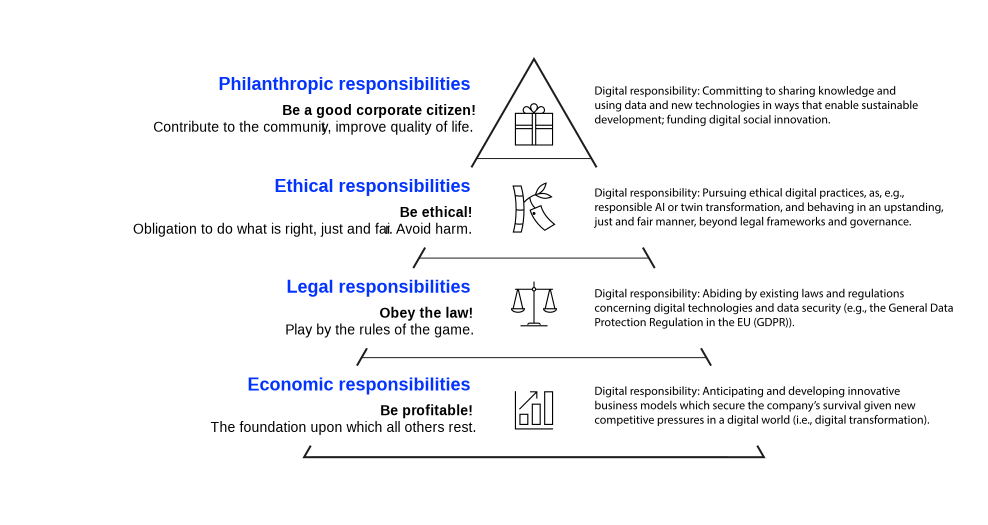
Carroll’s CSR pyramid (Carroll, 1991) helps managers recognize that different types of obligations are in constant tension with each other and are not mutually exclusive. The model includes four levels:
1. Economic responsibility (required by society)
Core principle: Be profitable
- Generate high and consistent profitability
- Establish and maintain strong competitive position
- Operate at high efficiency level
- Maximize sales, minimize costs
Stakeholder impact: Primarily affects owners, shareholders, and employees
Digital extension (Herden et al., 2021):
- Find innovative business models to secure competitive advantage in the digital world
- Leverage digital tools to optimize operations and improve efficiency
- Address new competitive pressures arising from digitalization
2. Legal responsibility (required by society)
Core principle: Obey all laws and regulations
- Operate consistently with government and legal expectations
- Show complete compliance with all regulations
- Adhere to laws governing business operations
Stakeholder impact: Affects owners, shareholders, employees, and consumers
Digital extension (Herden et al., 2021):
- Comply with data protection laws (e.g., GDPR in EU)
- Ensure cybersecurity compliance and data security regulations
- Address legal issues around emerging technologies (e.g., facial recognition)
- May require support from government, academics, or consultancies to manage complex digital regulations
3. Ethical responsibility (expected by society)
Core principle: Do what is right, fair, and just
- Meet expectations of social and ethical standards
- Adapt to new or developing ethical and moral standards
- Assert ethical leadership in industry and community
Stakeholder impact: Affects all stakeholder groups
Digital extension (Herden et al., 2021):
- Address ethical considerations related to data privacy, artificial intelligence, and automation
- Ensure digital practices do not exploit employees or consumers or the environment, but support it (i.e., twin transformation)
- Develop unbiased AI systems that treat all people fairly without discrimination
- Provide transparency in algorithms and AI decision-making
- Protect digital well-being and prevent technology addiction
- Ensure socially compatible automation with employee retraining and redeployment
- Safeguard digital freedom and human rights online
- Prevent digital surveillance overreach
Ethical responsibilities change over time based on societal expectations
4. Philanthropic responsibility (desired by society)
Core principle: Be a good corporate citizen
- Give to charitable organizations
- Provide community support programs
- Engage in voluntary social initiatives
Stakeholder impact: Most affects the community
Digital extension (Herden et al., 2021):
- Support digital social innovation initiatives
- Use technology to drive social good and enable sustainable development
- Promote digital inclusion to provide technology access in underserved communities
- Fund digital social entrepreneurship and innovation schemes
- Share knowledge and data for societal benefit
- Address digital divide through corporate programs
Note: Left to managerial judgment as society provides no clear guidance
| Type of Responsibility | Societal Expectation | Explanations |
|---|---|---|
| Economic responsibility | Required of business by society | Be profitable. Maximize sales, minimize costs |
| Legal responsibility | Required of business by society | Obey all laws, adhere to all regulations |
| Ethical responsibility | Expected of business by society | Do what is right, fair, and just. Assert ethical leadership |
| Philanthropic responsibility | Desired/expected of business by society | Be a good corporate citizen. |
The pyramid structure suggests that economic and legal responsibilities form the foundation, with ethical and philanthropic responsibilities building upon them.
Recent research by Schwartz & Carroll (2003) has critiqued the hierarchical nature of the pyramid, arguing for a more integrated approach where all dimensions can be simultaneously important.
Corporate Digital Responsibility
Herden et al. (2021) identify 20 key topics organized by ESG dimensions:
Environmental topics:
- Energy and carbon footprint of ICT infrastructure
- Digital waste and e-waste management
Social topics:
- Digital cohesion (seamless technology integration)
- Digital influence and responsible platform oversight
- Digital well-being and healthy technology use
- Digital empowerment and increased opportunities
- Socially compatible automation
- Unbiased AI and algorithmic fairness
- Digital self and online identity management
- Digital inclusion and accessibility
- Digital surveillance and privacy protection
- Digital freedom and human rights online
Governance topics:
- Reliability of digital systems
- Data transparency
- Data collection and storage practices
- Data ownership and privacy rights
- Data responsibility and stewardship
- Data security
- Data usage and accessibility
- Robot ethics and autonomous systems
CSR-performance relationship
Research by Barnett & Salomon (2012) suggests an U-shaped relationship between social and financial performance for many organizations:
Key insights:
- Moderate social responsibility can positively impact financial performance
- Excessive social responsibility might not necessarily lead to better financial results
- Need to find optimal level aligned with strategic goals and business context
- Strategic balance required between social responsibility and financial objectives
The authors emphasize that while moderate level of social responsibility can be associated with improved financial performance, pursuing excessive social responsibility might not always be conducive to improved financial outcomes. The findings call for strategic balance in integrating social responsibility into business practices.
This challenges both economists (who generally say CSR doesn’t pay) and philanthropists (who say it always does) by suggesting the relationship is more nuanced and context-dependent.
Meta-analysis by Margolis & Walsh (2003) examining 127 studies found a small but positive correlation between CSR and financial performance, while Orlitzky et al. (2003) found stronger relationships when CSR is strategically aligned with business capabilities.
Strategic investment decisions
The U-shaped relationship suggests organizations must make strategic choices about CSR investment levels:
Underinvestment risk
Organizations that invest too little in CSR may miss opportunities for:
- Stakeholder value creation and loyalty building
- Competitive differentiation through responsible practices
- Risk mitigation and reputation protection
- Access to socially conscious consumers and investors
Overinvestment risk
Excessive CSR investment may result in:
- Resource diversion from core business activities
- Diminishing returns on social investment
- Stakeholder skepticism about authenticity
- Competitive disadvantage if costs exceed benefits
Optimal investment zone
CSR initiatives should be:
- Aligned with organizational core competencies and capabilities
- Responsive to key stakeholder priorities and expectations
- Integrated with business strategy rather than peripheral add-ons
- Measurable in terms of both social and business impact
Organizations can identify their optimal investment level through stakeholder analysis, materiality assessments, and business case development for each CSR initiative.
Implementation
Contextual ambidexterity
Firms need contextual ambidexterity—the ability to exploit current profitable technologies (economic responsibility) while exploring ethical/sustainable future innovations (ethical responsibility) simultaneously.
Strategic response framework
Given that there are always grounds for ethical strategic concerns, it is desirable to develop ethics sensitivity in the company, and a routine to probe the general ethical climate of the firm (Mintzberg, 2014).
Strategic response framework:
- Identify core values: Establish clear organizational values and principles that guide decision-making
- Teach employees about ethics: Educate employees about ethical behavior and decision-making processes
- Make moral views clear: Communicate standards throughout organization with clear and consistent expression of moral convictions
- Plan for the future: Anticipate and prepare for ethical challenges ahead, including possible cultural and value-related changes
Implementation mechanisms:
- Codes of conduct: Useful means of influencing ethical climate when properly implemented and visibly supported by management
- Cultural expression: Has strong unifying cultural effect and provides intellectual power to manage ethical conflicts
- Future preparation: Predict and prepare for cultural and value-related changes
Ethics x strategic analysis
CSR affects customer willingness to pay, cost structures, employee satisfaction, and supplier relationships.
Ethics and CSR considerations should, thus, be integrated into both external and internal audits as sources of opportunities and threats, strengths and weaknesses.
Value creation through CSR
Willingness to pay — Customers may pay premium for socially responsible products
- Sustainable products command price premiums
- Ethical sourcing appeals to conscious consumers
- Environmental benefits create differentiation
Cost structure — CSR initiatives may reduce long-term operational costs
- Energy efficiency reduces utility costs
- Waste reduction lowers disposal expenses
- Employee engagement reduces turnover costs
Employee value (WTS) - strong CSR enhances employee satisfaction and reduces turnover costs
- Purpose-driven work increases engagement
- Values alignment improves retention
- CSR attracts top talent
Supplier relations (WTS) — ethical practices improve supplier relationships and terms
- Fair trade practices build supplier loyalty
- Long-term partnerships reduce procurement costs
- Ethical sourcing creates stable supply chains
CSR in external audit
Environmental factors to consider
- Social and cultural expectations regarding corporate responsibility
- Environmental regulations and sustainability standards
- Stakeholder activism and pressure groups
- Industry sustainability trends and benchmarks
Opportunities from CSR
- New market segments interested in sustainable products
- Partnership opportunities with NGOs and social organizations
- Government incentives for sustainable practices
- Enhanced reputation and brand value
Threats from poor CSR
- Consumer boycotts and negative publicity
- Regulatory penalties and legal action
- Investor pressure and divestment
- Talent retention and recruitment challenges
CSR in internal audit
Strengths from strong CSR
- Enhanced employee engagement and retention
- Strong stakeholder relationships
- Sustainable cost advantages
- Innovation capabilities driven by social/environmental challenges
Weaknesses from poor CSR
- Reputational vulnerabilities
- Regulatory compliance gaps
- Limited access to certain markets or talent
- Higher operational risks
Implementation framework
Practical framework for implementing ethical strategy:
- Ethical audit integration:
Include ethical factors in SWOT analysis and strategic reviews (Carroll, 2004) - Stakeholder impact assessment:
Evaluate strategic options through comprehensive stakeholder lens (Harrison et al., 2010) - Ethical risk management:
Identify and mitigate ethical risks in strategy implementation (Kaplan & Norton, 2012) - Performance metrics:
Develop KPIs balancing financial and ethical outcomes (Kaplan & Norton, 2001) - Cultural alignment:
Ensure organizational culture supports ethical strategy execution (Schein, 2010)
Decision heuristics
How do we translate abstract ethical strategy into daily decisions?
The “gut” checks
— quick heuristics for immediate assessment
- The newspaper test: How would this strategic choice look on the front page of the WSJ?
- The universality test: Would we be comfortable if our competitors or suppliers did this to us?
- The mom test: Would you be proud to explain this decision to a family member?
The process check — for (digital) product development contexts
- Intended: What are the product vision and target benefits?
- Unintended: What are the potential negative side effects?
- Mitigation: Who is the most vulnerable user, and how do we protect them?
While strategy sets the direction, ethics lives in the micro-decisions made by teams every day. We need heuristics to bridge the gap between the “CSR Pyramid” and the code commit.
The “gut” checks are rapid reputational risk assessments. The newspaper test (famously used by Warren Buffett) connects directly to the amplification effect we discussed earlier—decisions in a digital age are rarely private. The process check refers to consequence scanning. It is an agile ceremony that fits into sprint planning. Instead of asking “Can we build it?”, it forces the engineering and product teams to ask “What happens if this works better than we expect?” or “How could this feature be weaponized?”
These checks convert ethics from a compliance bottleneck into a design feature, reducing ethical debt later in the lifecycle.
Ethics in practice: Patagonia
Are there examples from (big) tech too?
Patagonia’s $10 million tax cut donation to environmental causes illustrates how ethical decisions can create strategic value:
- Customer value: the tax cut donation reinforced Patagonia’s environmental positioning, strengthening customer loyalty among environmentally conscious consumers willing to pay premium prices.
- Employee value: the tax cut donation attracted and retained employees who share environmental values, improving engagement and reducing turnover costs.
- Media value: the tax cut donation generated extensive positive media coverage, providing marketing value far exceeding the $10 million donation.
- Brand value: the tax cut donation strengthened Patagonia’s authentic positioning as an environmental advocate, differentiating it from competitors perceived as “greenwashing.”
Overall, The decision aligned with Patagonia’s mission and long-term business sustainability strategy, as environmental degradation threatens outdoor recreation markets.
This example demonstrates how ethical decisions that appear costly in the short term can create significant strategic value when aligned with organizational purpose and stakeholder expectations.
Similar examples include Ben & Jerry’s social activism, Interface Inc.’s Mission Zero environmental initiative, and Unilever’s Sustainable Living Plan - all demonstrating strategic value creation through ethical positioning.
Ethics in practice: Anthropic
Antrophic was founded by former OpenAI executives who left due to “safety drift”, structured as a Public Benefit Corporation (PBC) to legally shield safety priorities from profit maximizing.
- Structural ambidexterity: anthropic is a PBC, meaning the board has a fiduciary duty to the mission, not just shareholders. This allows them to raise billions (Amazon/Google) while legally prioritizing safety.
- Ethical debt vs. tech debt: by delaying their release to build “Constitutional AI,” they paid a huge short-term cost (market share lost to ChatGPT). However, they argue this reduces ethical debt—the risk of their model causing catastrophic harm later that would destroy the company.
- The Decision Heuristic: their “Constitutional AI” is the ultimate implementation of the “Newspaper Test.” They literally teach the AI to ask: “Is this response helpful, honest, and harmless?” before generating output.
Key takeaways
- Ethics foundations provide the basis for all business ethical decisions through understanding right and wrong conduct
- Cultural and temporal variation in moral systems creates complexity for global organizations
- Strategic amplification effects make organizational ethics critically important due to scale, time, complexity, and visibility
- CSR pyramid shows four responsibility levels with different societal expectations and business implications
- U-shaped CSR relationship requires strategic balance between underinvestment and overinvestment in social responsibility
- Implementation framework demands integration across audit processes, risk management, and cultural alignment
- Value creation mechanisms demonstrate how ethics enhance rather than constrain strategic performance across stakeholder relationships
Review and consolidation
The following questions are designed to review and consolidate what you have learned and are a good starting point for preparing for the exam.
- Define ethics and explain how moral systems vary across cultures and time periods.
- Explain the concept of corporate moral responsibility and how it differs from individual ethical responsibility.
- Provide examples of ethical dilemmas in business. How should organizations approach and resolve these ethical challenges?
- Describe Carroll’s CSR pyramid and analyze the strategic implications of each level.
- Analyze the U-shaped relationship between CSR investment and financial performance. What factors determine optimal CSR investment levels?
- Compare and contrast different approaches to implementing ethical strategies in organizations.
- Discuss how ethical considerations should be integrated into strategic analysis frameworks (external and internal audits).
- Analyze how contemporary challenges (AI, data privacy, climate change) create new ethical strategic imperatives for organizations.
- Evaluate the mechanisms through which ethical strategies create value for different stakeholder groups.