Competition and Positioning
Strategy and Performance Management
Learning objectives
After this section, you should have a solid understanding of
- the nature and purpose of an external audit in formulating strategies;
- major external forces that impact organizations;
- Porter’s Five-Forces Model and its relevance in formulating strategies;
- Porter’s three generic strategies and their application;
- Ansoff’s growth matrix and strategic alternatives;
- and the impact of megatrends on strategic management.
External perspective
External audit
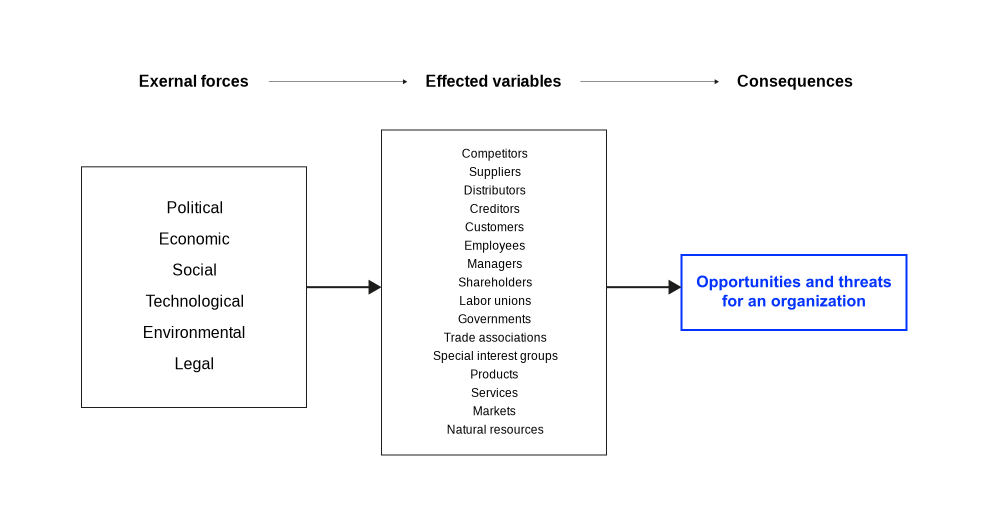
The essence of strategy formulation is coping with competition. Competition is caused not only by other players, but also by the broader environment (Mintzberg, 2014). The external strategic management audit focuses on identifying and evaluating environmental trends and events beyond the control of a single firm (David & David, 2016).
The purpose of an external audit is to develop a finite list of opportunities that could benefit a firm as well as threats that should be avoided. The external audit is aimed at identifying key variables that offer actionable responses, not developing an exhaustive list of every possible factor.
Identifying and evaluating external opportunities and threats enables organizations to develop a clear mission, design strategies to achieve long-term objectives, and develop policies to achieve annual objectives.
PESTEL framework
External forces can be systematically analyzed using the PESTEL framework (David & David, 2016):
Political forces
- Political conditions in countries and regions
- Level of defense expenditures and government priorities
- Protectionist actions and trade policies
- Political stability and policy continuity
- Government involvement in the economy
Economic forces
- Shift to service economy, availability of credit, level of disposable income
- Interest rates, inflation rates, GDP trends, consumption patterns
- Unemployment trends, currency rates, import/export factors
- Stock market trends, tax rate variations, economic policies
- Income differences by region and consumer group
Social forces
- Population changes by race, age, and geographic area
- Regional changes in tastes and preferences, lifestyle changes
- Social media pervasiveness, attitudes toward product quality
- Education levels, cultural values, and demographic shifts
- Health consciousness and social responsibility issues
Technological forces
- AI, Internet of Things, 3D printing, biotech, robotics
- Innovation cycles and technology adoption rates
- Digital transformation and automation
- R&D activity and technology transfer rates
- Patent protection and intellectual property issues
Environmental forces
- Energy conservation and environmental regulations
- Climate change impacts and sustainability concerns
- Waste disposal and recycling requirements
- Attitudes toward “green” products and carbon footprint
- Environmental protection laws and initiatives
Legal forces
- Changes in patent laws, equal employment opportunity laws
- Antitrust legislation and regulatory compliance
- Local, state, and federal laws affecting business operations
- Import-export regulations and international trade laws
- Health and safety regulations, consumer protection laws
When identifying and prioritizing key external factors in an external audit, make sure the factors selected are (1) specific (i.e., quantified to the extent possible); (2) actionable (i.e., meaningful in terms of having strategic implications); and (3) stated as external trends, events, or facts rather than as strategies the firm could pursue (David & David, 2016).
Visualization
Porter’s Five-Forces Model
The essence of strategy is coping with competition.
PESTEL forces influence the competitive landscape by shaping competitive forces. Porter proposes to (also) analyze these thoroughly.
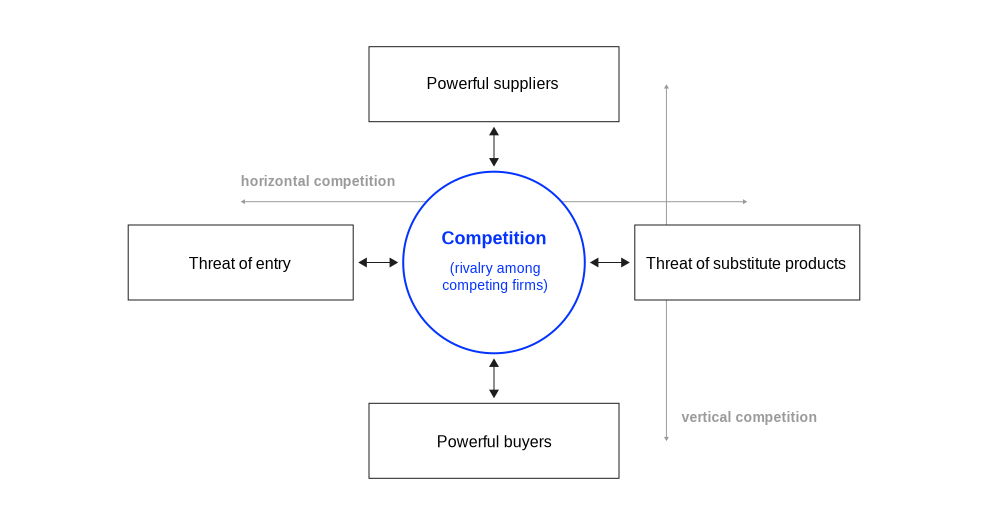
Porter’s Five-Forces Model of competitive analysis is a widely used approach for identifying key competetive forces and developing strategies in many industries (Porter, 1986).
According to Porter (1986), the state of competition in an industry depends on five basic forces. The collective strength of these forces determines the ultimate profit potential of that industry. Knowledge/analysis of the underlying sources of competitive pressures provides the groundwork for effective strategic courses of action.
Visualization
Threat of entry
New entrants bring new capacity, substantial resources and desire to gain market share. The seriousness depends on barriers of entry:
Six major sources of barriers to entry are:
- Economies of scale: Cost advantages from large-scale operations
- Product differentiation: Brand loyalty and switching costs
- Capital requirements: Financial resources needed to compete
- Cost disadvantages independent of size: Access to raw materials, technology
- Access to distribution channels: Established distributor relationships
- Government policy: Regulations limiting or preventing entry
Deterrent factors:
- Previous attacks on new entrants by incumbents
- Substantial resources to fight back (cash, borrowing power, capacity)
- Ability to cut prices to maintain market share
- Industry-wide excess capacity and slow growth
Powerful suppliers and buyers
Suppliers are powerful when:
- Dominated by few companies, more concentrated than buying industry
- Products are unique, differentiated, or have high switching costs
- Not obliged to contend with substitute products
- Pose credible threat of forward integration
- Industry is not important customer
Buyers are powerful when:
- Concentrated or purchase in large volumes
- Products purchased are standard/undifferentiated
- Purchases represent significant fraction of buyer’s costs
- Earn low profits, creating incentive to lower costs
- Industry’s product unimportant to buyer’s quality
- Pose credible threat of backward integration
Substitute products
Substitute products limit industry potential by placing ceiling on prices. More attractive price-performance trade-off = greater impact on profitability.
Key substitutes are those subject to trends improving price-performance and produced by industries earning high profits.
Intensity of rivalry
Rivalry intensifies when:
- Competitors numerous or roughly equal in size and power
- Industry growth slow, precipitating market share fights
- Products lack differentiation or switching costs
- Fixed costs high or products perishable
- Capacity augmented in large increments
- Exit barriers high
- Rivals diverse in strategies, origins, and ‘personalities’
Megatrends
The concept of megatrends refers to long-term, global, and transformative trends that significantly impact various aspects of society, economy, industries, and organizations. These trends are characterized by their sustained and pervasive influence over many years, often spanning decades.
Key characteristics:
- Long-term perspective: unfold over 10-20+ years
- Global impact: transcend geographical boundaries
- Transformational effects: bring fundamental changes in demographics, technology, environment, politics, culture
- Cross-industry relevance: impact multiple industries and sectors
- Strategic implications: must be considered in strategic planning processes
Examples
The Zukunftsinstitut identifies 12 long-term, transformative forces that impact all aspects of society, economy, and individual lives:
Globalisation, urbanization, silver society, health
new work, knowledge culture, connectivity,
mobility, neo-ecology, individualization, gender-shift,
and security.
- Globalization: increasing interconnectedness through trade, communication, cultural exchange
- Urbanization: growth of cities and rural-to-urban population shift
- Silver Society: aging population and associated societal changes
- Health: growing focus on health, well-being, medical technology advances
- New Work: remote work, flexible hours, gig economy changes
- Knowledge Culture: importance of knowledge and education in modern world
- Connectivity: rise of digital connectivity and Internet of Things
- Mobility: innovations in transportation and movement of people/goods
- Neo-Ecology: shift towards sustainable and environmentally friendly practices
- Individualization: trend towards personalized and individualized lifestyles
- Gender Shift: changes in gender roles and move towards equality
- Security: increasing focus on safety and security in various life aspects
Positioning
Porter’s generic strategies
Porter (1980) proposed three generic strategies that organizations can pursue to gain competitive advantage in their respective industries. These strategies are based on the scope of the target market and the competitive advantage sought.
Cost leadership strategy
Focus on becoming lowest-cost producer in industry:
- Achieve through economies of scale, efficient operations, cost-saving measures
- Target broad market scope with competitive pricing
- Maintain profitability while offering lower prices than competitors
Risks: Intense price competition, potential need to sacrifice quality/innovation
Differentiation strategy
Offer unique products or services with distinct value:
- Achieve through innovation, quality, branding, customer service
- Target broad market willing to pay premium prices
- Create products perceived as superior
Risks: Sustaining differentiation requires ongoing investment, vulnerability to imitation
Focus strategy
Target specific market segment or niche:
- Concentrate on serving unique needs better than competitors
- Can be cost focus (lower prices within niche) or differentiation focus (specialized products)
- Build strong relationships within targeted segment
Risks: Vulnerability to changes in chosen market, competition from larger players
Stuck in the Middle
Inability to pursue one generic strategy effectively:
- Cannot justify higher prices (lacks differentiation)
- Lacks cost structure to compete on price
- Struggles to attract customers and achieve competitive advantage
- Demonstrates need for clear strategic focus and trade-offs
Ansoff’s Growth Matrix
The Ansoff-matrix (Ansoff, 1965) is a strategic planning framework that helps businesses determine growth strategies by examining their current and potential markets and products. The matrix groups growth strategies based on two main factors: products (what they offer) and markets (who they serve).
Market penetration
Increase market share and sales within existing markets with existing products:
- Focus on selling more to current customer base
- Tactics include price adjustments, marketing campaigns, enhancing customer loyalty
Consider when: Markets not saturated, customer usage rates can increase, competitors’ market shares declining, economies of scale offer advantages
Example: Coca-Cola using market penetration through increased marketing efforts and seasonal promotions
Market development
Expand into new markets or customer segments with existing products:
- Identify and enter new geographic regions or demographic segments
- Leverage existing market knowledge and customer base
Consider when: New reliable distribution channels available, organization highly successful, untapped markets exist, excess production capacity available
Example: Starbucks expanding into Asia (China, India) with existing coffee products
Product development
Create and introduce new products or services into existing markets:
- Leverage existing market knowledge and customer relationships
- May involve R&D efforts or technology acquisitions
Consider when: Products in maturity stage, rapid technological developments, competitors offer better products, strong R&D capabilities exist
Example: Apple introducing new iPhone, iPad, MacBook versions to existing customer base
Diversification
Enter entirely new markets with new products or services:
- Most ambitious and risky strategy
- Can be related (limited connection) or unrelated (no connection) diversification
Consider related diversification when: Competing in slow-growth industry, adding related products enhances sales, strong management team exists
Consider unrelated diversification when: Competing in highly competitive industry, new products significantly increase revenue, financial synergy exists
Example: Amazon diversifying from e-commerce to cloud computing (AWS), entertainment (Prime Video), grocery retail (Whole Foods)
Blue ocean strategy
Blue ocean strategy is a business strategy framework that encourages organizations to seek new and uncontested market spaces, where they can create and capture value without intense competition (Kim & Mauborgne, 2005).
Key concepts:
- Blue ocean: Uncharted waters free from competition
- Red ocean: Saturated and highly competitive markets
- Value innovation: Simultaneous pursuit of differentiation and low cost
The strategy focuses on creating new demand rather than fighting over existing demand, making competition irrelevant by opening up new and uncontested market space.
The four actions framework helps organizations break the value-cost trade-off and create blue ocean:
- Eliminate: What factors that the industry takes for granted should be eliminated?
- Reduce: What factors should be reduced well below the industry’s standard?
- Raise: What factors should be raised well above the industry’s standard?
- Create: What factors should be created that the industry has never offered?
This framework forces companies to examine every factor of competition, guiding them to pursue both differentiation and low cost simultaneously.
- Eliminate: Complex graphics capabilities, massive storage capacity, DVD playback
- Reduce: Processing power, price point compared to Xbox 360/PS3
- Raise: Ease of use, family-friendly games, reliability
- Create: Motion-sensor controllers, active gaming experience, appeal to non-gamers (elderly, families)
While Sony and Microsoft fought for hardcore gamers, Nintendo attracted casual gamers, families, and seniors—a blue ocean.
Identifying blue oceans
Six paths to blue oceans:
- Look across industries: Identify alternatives serving similar functions
- Look across strategic groups: Analyze different strategic groups within industries
- Look across buyer groups: Examine chain of buyers influencing purchasing
- Look across complementary offerings: Consider complementary products and services
- Look across functional/emotional appeal: Balance rational and emotional buyer appeals
- Look across time: Identify and leverage trends shaping the future
Three tiers of noncustomers:
- Soon-to-be noncustomers: Currently dissatisfied, likely to leave if needs not addressed
- Refusing noncustomers: Consciously choose not to engage despite having alternatives
- Unexplored noncustomers: Never considered as potential customers, fall outside traditional boundaries
By understanding and converting these noncustomers, organizations can unlock new sources of demand and create blue ocean opportunities.
Trade-offs
For instance, positioning trade-offs arise for three reasons (M. Porter, 1996):
- Inconsistencies in image or reputation: Different positions require different branding
- Different configurations required: Different positions need different product configurations, equipment, skills, management systems
- Limits on coordination and control: Internal limitations on managing multiple approaches
Positioning trade-offs are essential to strategy because they:
- Create the need for choice and purposefully limit what company offers
- Deter ‘straddling’ and ‘repositioning’ by competitors
- Force organizations to make clear strategic commitments
- Enable focus and resource concentration
Two-way door decisions
Some decisions are consequential and irreversible or nearly irreversible —one-way doors— and these decisions must be made methodically, carefully, slowly, with great deliberation and consultation. If you walk through and don’t like what you see on the other side, you can’t get back to where you were before. We can call these Type 1 decisions. But most decisions aren’t like that —they are changeable, reversible— they’re two-way doors. If you’ve made a suboptimal Type 2 decision, you don’t have to live with the consequences for that long. You can reopen the door and go back through. Type 2 decisions can and should be made quickly by high judgment individuals or small groups. Jeff Bezos, 2015 Letter to the shareholders
A two-way door decision is a concept popularized by Jeff Bezos, referring to decisions that are easily reversible. If you make a two-way door decision and it turns out to be wrong, you can simply “walk back through the door” and return to your previous state without significant consequences.
Implications for strategic management:
- Flexibility and agility: Two-way door decisions allow organizations to be more flexible and agile. Since these decisions can be reversed, they encourage experimentation and innovation without the fear of long-term negative impacts.
- Speed of decision-making: These decisions can be made quickly, enabling faster responses to market changes and opportunities. This can be a significant competitive advantage in dynamic industries.
- Risk management: By distinguishing between one-way (irreversible) and two-way (reversible) decisions, companies can allocate resources and attention more effectively. Critical, irreversible decisions can be given the thorough analysis they require, while reversible decisions can be made swiftly.
- Empowerment: employees can be empowered to make two-way door decisions on their own, fostering a culture of trust and autonomy. This can lead to higher job satisfaction and innovation.
Key takeaways
- External audit provides systematic approach to identifying opportunities and threats in the environment
- Five external forces (economic, SCDE, political/legal, technological, competitive) must be analyzed for strategic relevance
- Megatrends shape long-term strategic context and create both opportunities and threats over 10-20+ year periods
- Porter’s Five Forces help understand industry structure and competitive dynamics affecting profit potential
- Generic strategies offer frameworks for finding effective positions in the marketg and achieving competitive advantage (e.g., Porter’s generic strategies, Ansoff matrix, blue ocean strategy)
- Trade-offs are essential — strategy is as much about choosing what not to do as choosing what to do
- Climate change represents critical strategic factor requiring robust decision-making under uncertainty
Review and consolidation
The following questions are designed to review and consolidate what you have learned and are a good starting point for preparing for the exam.
- Describe the nature and purpose of an external assessment in formulating strategies.
- What is Porter’s Five-Forces Model and what is its relevance in formulating strategies?
- What are (legal) key sources of information for identifying opportunities and threats?
- Why is [a megatrend] considered as a megatrend? Justify your answer.
- How have external factors resulted in a major overhaul to the traditional retail industry as we once knew it?
- Describe how political elections can be an important external factor for companies to consider. Select an industry and reveal some key political factors impacting firms.
- Explain how Facebook, Twitter, and Instagram can represent a major threat or opportunity for a company in different industries.
- Discuss the following statement: Major opportunities and threats usually result from an interaction among key environmental trends rather than from a single external event or factor.
- Do you agree with Porter’s view that competitive positioning within an industry is a key determinant of competitive advantage(s)?
- Explain the effects of [a generic strategy] on the value stick framework.
- Why do anual reports often state external risk information in really vague terms; why should strategists avoid including such vagueness in external assessments (e.g., in developing an EFE Matrix)?
Homework
Read Peteraf (1993) and make notes on following:
- Define the Resource-Based View (RBV) — how does it differ from other strategy perspectives?
- Identify key resource types (tangible, intangible, human) and give examples from the paper.
- Explain resource heterogeneity — why is it central to competitive advantage in RBV?
- Explain resource immobility — how does it support sustained advantage?
- Define dynamic capabilities — how do they enable adaptation and innovation?
- Link resources to value creation — how do they drive advantage for customers?
- Explain performance differences — why do some firms consistently outperform others?
- Derive implications for strategy — how should firms apply RBV to compete effectively?
Literature
Footnotes
GenAI industry refers to the industry concerned with developing large foundation models for e.g., text, image and video generation; main players are OpenAI, X, Meta, Antrophic, and Mistral).↩︎