awe — academic resource hub
  • Start

Slides

IS/IT Strategy

Strategy and Performance Management

Admin
Author

Andy Weeger

Published

Jan 12, 2026

Modified

Nov 28, 2026

On this page

  • Learning outcomes
  • Definition
  • Process
  • Deliverables
  • Conclusions
  • Review and consolidation
  • Homework
  • Literature

Learning outcomes

After this session, you should have a solid understanding of

  • different perspectives of IS strategy,
  • the interactions of IS strategy and business strategy,
  • the scope, contents, structure of an IS strategy and other deliverables,
  • the process to identify investment priorities, and
  • critical success factors for crafting and implementing IS strategies.

Definition

Conceptions in literature

Chen et al. (2010) identified three conceptions of information systems (IS) strategy in IS literature:

  1. IS strategy as the use of IS to support business strategy
    (position — how can IS be used to support the intended position?;
    business-centric; part of business strategy; a priori alignment)
    ;
  2. IS strategy as the master plan of the IS function
    (plan — what IS assets are required and how to allocate the existing ones efficiently?;
    IS-centric; functional-strategy; ex post alignment)
    ; and
  3. IS strategy as the shared view of the IS role within the organization
    (perspective — what is our view towards IS in the organization?;
    organization-centric; organizational-level strategy; dynamic alignment)
    .

The three conceptions in literature differ in terms of the contextual elements of the IS strategy (process, content, desired impact, and alignment).

Definition

Conceptions 1 and 2 either subordinate IS strategy to business strategy or reduce it to functional planning. Only the third conception positions IS strategy as a distinct organizational-level construct.

IS strategy refers to the organizational perspective on the investment in, deployment, use, and management of IS. (Chen et al., 2010, p. 237).

The intended impact of IS/IT strategy1 is to provide a shared understanding across the organization to guide subsequent IS/IT investment and deployment decisions.

This definition follows the paradigm of perspective (Mintzberg, 1987) to define strategy at an organizational level that reflects the opinions from both business and IS sides. Thus, an effective IS strategy needs to be neither only business-centric nor only IS-centric. In addition, following an organizational perspective approach avoids the contradicting views on emergent versus deliberate strategies (Chen et al., 2010).

By framing IS strategy as a perspective, the definition captures something more enduring and fundamental than a plan or document. It reflects the organization’s collective mindset about what role IS should play—whether as an innovation driver or a conservative efficiency enabler.

This definition has been influential in the IS strategy literature because it provides a more robust theoretical foundation and enables clearer measurement compared to earlier, more fragmented conceptualizations.

Conceptual framework

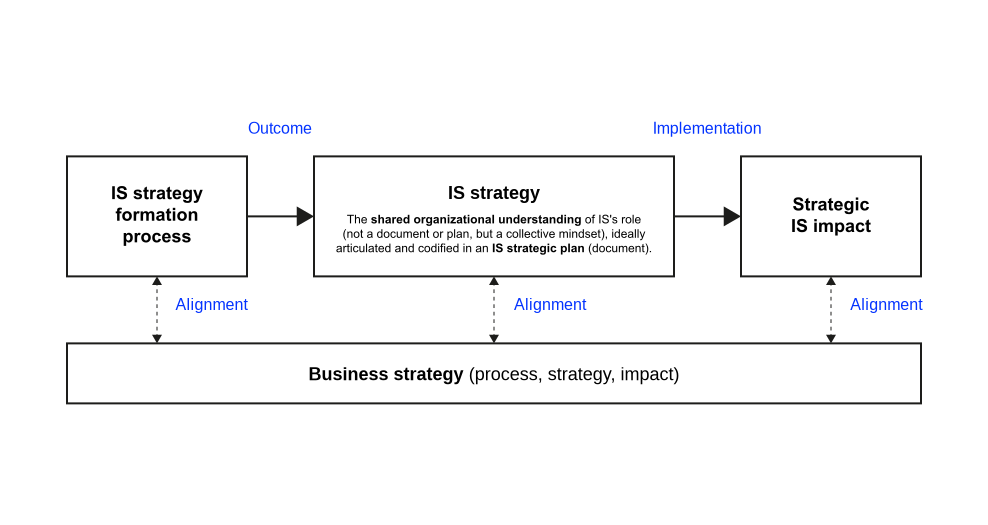
Figure 1: Based on Chen et al. (2010)’s framework of IS strategy

The framework illustrates how Chen et al. position IS strategy as a distinct organizational-level construct.

  • The IS strategy development process represents how the organization forms its perspective—through discussions, experiences, and decisions about where to invest IS resources.
  • The central IS strategy box is the organizational perspective itself—the shared understanding of IS’s role that emerges from this process. This is not a document or plan, but a collective mindset.
  • IS strategic implementation translates this perspective into concrete actions—how the organization actually deploys and uses its IS assets.

Notice that all three boxes have bidirectional dashed arrows connecting to business strategy. This represents dynamic alignment—a continuous, mutual adjustment rather than a one-time planning exercise.

  • In conception 1, alignment would be a one-way arrow from business strategy to IS (IS follows business).
  • In conception 2, alignment would be an ex-post check (does our IS plan fit the business plan?).
  • In conception 3, Chen et al. (2010)’s view—alignment is ongoing and bidirectional. IS strategy shapes and is shaped by business strategy simultaneously.

Process

The IS strategy process

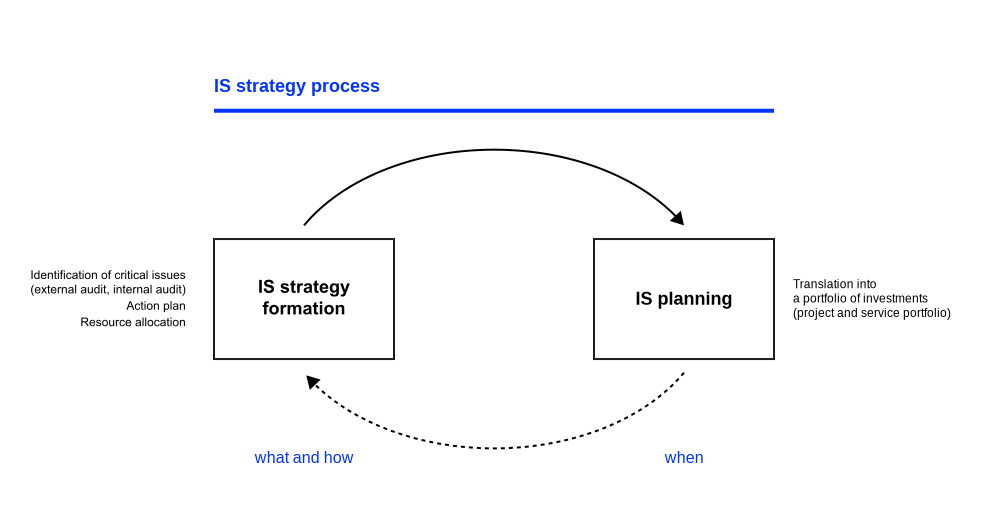
Figure 2: The IS strategy process, based on Peppard & Ward (2016)

Peppard & Ward (2016) distinguish between IS strategy formulation and IS planning. Formulation encompasses processes for identifying alignment, innovation and competitive influence options — what we want to do as an organization and how we can do it, but not when. Once the strategy is formulated, an implementation plan can be created based on the best way to meet the prioritized needs.

The focus is then on implementation, and will include the definition of a portfolio of investments that need to be executed. While the formulation of the IS strategy drives the IS planning, aspects may come to light during the creation of the plan that cause the original strategy to be reconsidered.

Strategy formation

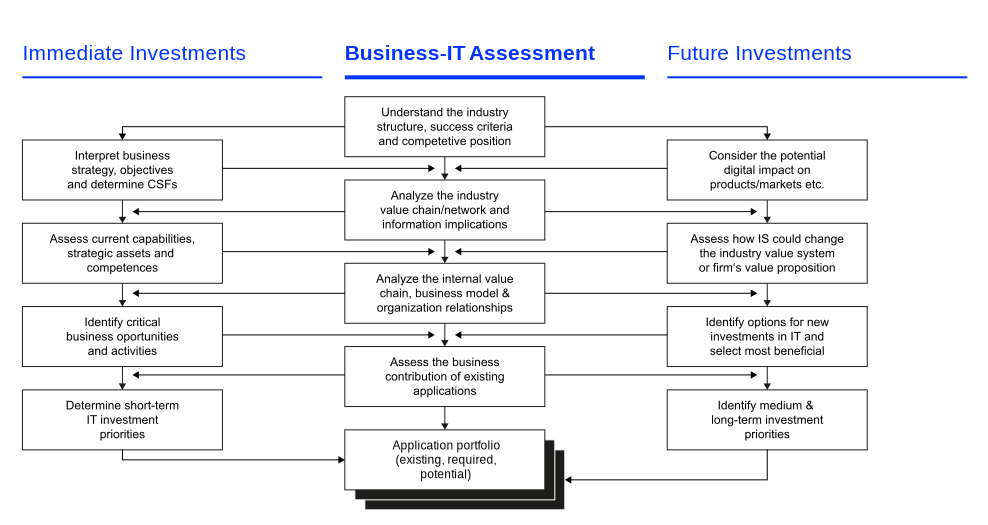
The Peppard & Ward (2016) IS/IT strategy planning framework provides a structured process for aligning IT investments with business strategy. It operates through three parallel streams that feed into a unified application portfolio:

  • Middle stream (analysis): Provides the analytical foundation by examining industry context, value chains, and existing systems—connecting business reality with IT possibilities.
  • Left stream (short-term): Starts from existing business strategy and current capabilities to identify immediate IT needs—what must be fixed or improved now to support today’s operations.
  • Right stream (Long-term): Explores how emerging technologies could transform the business model, markets, or competitive position—identifying future-oriented investments.

The three streams converge in an application portfolio that categorizes systems as existing, required, or potential—enabling prioritized investment decisions.

Figure 3: Strategy planning framework based on Peppard & Ward (2016)
Business-IT Assessment Immediate Investments Future Investments
Industry context: Competitors adopting predictive maintenance; data becoming competitive differentiator Business strategy: Cost leadership through operational excellence; CSF: minimize unplanned downtime Digital impact: AI could enable “maintenance-as-a-service” for customers’ equipment
Value chain analysis: Production data exists but not integrated; maintenance is reactive and costly Current capabilities: Strong engineering talent; weak data infrastructure; siloed machine data Value proposition change: Shift from selling machines to guaranteeing uptime via AI monitoring
Existing applications: ERP handles transactions; no analytics; SCADA systems unconnected Critical opportunities: Reduce 12% downtime rate; improve quality consistency Investment options: Predictive maintenance AI (high value), Quality vision system (medium), Generative AI for documentation (lower)
Portfolio: Existing: ERP, SCADA; Required: Data platform, ML ops; Potential: Predictive AI, GenAI assistants Short-term priorities: Data lake infrastructure, sensor integration layer, basic analytics dashboards Long-term priorities: Predictive maintenance pilot, scale AI across plants, customer-facing AI services
Table 1: Example of the application of the strategy planning framework

Exercise

Scenario: You are the IT steering committee of MediPharm AG, a mid-sized German pharmaceutical distributor supplying hospitals and pharmacies. The company operates 5 regional warehouses and employs 800 people. Recent challenges include new competitors offering same-day delivery, increasing regulatory requirements for drug traceability, and pressure from customers to digitize ordering processes.

  • Have a look at the IT/IS strategy planning framework as proposed by Peppard & Ward (2016) (Figure 3}
  • Work through the three streams and answer the questions raised in the table below.
  • Derive your top 3 investment priorities (mix of short-term and long-term) with a brief justification of how each connects to the business strategy.

Template/guideline:

Business-IT Assessment Immediate Investments Future Investments
Industry context: What are competitors doing? What role does IT play in the industry? Business strategy & CSFs: What is MediPharm’s competitive position? What must go right? Digital impact: How could emerging technology (AI, IoT, platforms) change the market?
Value chain analysis: Where does information flow? Where are the gaps? Current capabilities: What are IT strengths and weaknesses today? Value proposition change: How could IS transform what MediPharm offers?
Existing applications: What systems exist? How well do they support the business? Short-term priorities: Which IT investments are urgent (next 12 months)? Long-term priorities: Which IT investments are strategic bets (2–5 years)?
25:00

General approaches to IS strategy

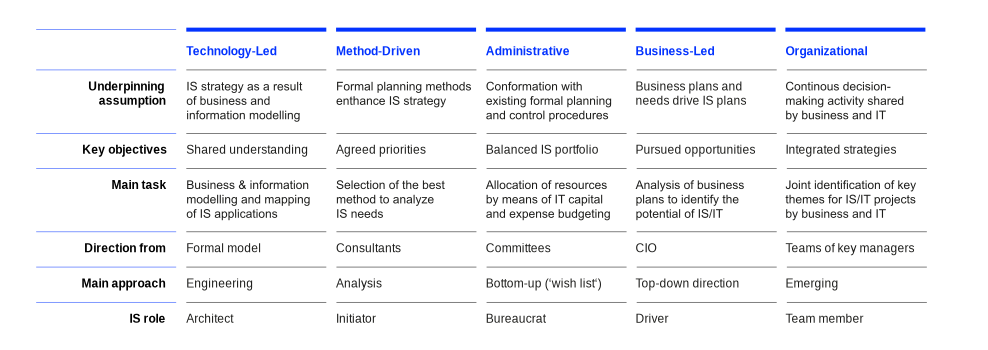
Earl (1993) identifies five distinct approaches to IS strategy formulation and IS planning within organizations.

Technology-led approach
This approach is centered around the capabilities and potential of technology itself. IT specialists lead that approach. It involves establishing the technology foundations, architectures, and capabilities to meet the anticipated application needs of business users.
Method-driven approach
This approach relies on structured methodologies and frameworks to guide the IT strategy formulation and implementation process. It involves using techniques (often a consultant’s methodology) to determine IT needs by analyzing business processes. It is based on a top-down analysis of information needs and relationships to create IS plans in the form of blueprints.
Administrative approach
This approach focuses on the formal processes and procedures of planning. It emphasizes documentation, standardization, and adherence to planning protocols, often involving detailed project management and governance structures. The main objective is to establish IT capital and expense budgets and resource plans to realize approved IS applications, usually based on a prioritized user wish list.
Business-led approach
This approach is driven by business needs and objectives. It emphasizes aligning IS strategy with the overall business strategy. Business plans, usually at a functional level, are analyzed to determine where IT is most critical to meeting short to medium term requirements. Senior management typically leads this approach, ensuring that IS initiatives support business goals and competitive advantage.
Organization-led approach
This approach considers the organizational culture, structure, and human factors in planning. It emphasizes the involvement of various stakeholders, fostering collaboration and ensuring that IS strategies are aligned with the organizational context and capabilities. It aims at the development of key themes for IT investment arising from an executive-agreed view of how IT can contribute to overall business objectives.
Figure 4: Approaches to strategic planning of the information systems based on Earl (1993)
Approach Example Description
Technology-led Google’s Cloud Infrastructure (2000s–2010s) Google engineers built MapReduce, BigTable, and containerization (later Kubernetes) before specific business applications existed. Technology capabilities were developed anticipating future needs—products like Gmail, Google Docs, and Cloud Platform emerged from this infrastructure foundation.
Method-driven SAP Implementations using ASAP Methodology Companies implementing SAP ERP follow the structured Accelerated SAP (ASAP) methodology: project preparation, business blueprint, realization, final preparation, go-live. Consultants analyze business processes systematically to configure the system according to predefined blueprints.
Administrative Government IT Procurement (e.g., German Federal IT Planning) Public sector IT planning follows formal budget cycles, detailed tender processes, and governance protocols. Departments submit IT requests, committees prioritize based on available budget, and approved projects follow standardized project management (e.g., V-Modell XT). Focus is on compliance and resource allocation.
Business-led Walmart’s Supply Chain Systems (1980s–1990s) Walmart’s business strategy of “everyday low prices” drove IT investments. Senior management identified inventory cost as critical, leading to pioneering investments in barcode scanning, EDI with suppliers, and cross-docking systems—all derived from specific business objectives.
Organization-led ING’s Agile Transformation (2015+) ING Netherlands transformed IT strategy through executive-led organizational change. Leadership defined themes like “customer centricity” and “speed to market,” then restructured into cross-functional squads and tribes. IT investments followed from agreed organizational priorities, not technology or methodology.
Table 2: Examples for the five distinct approaches to strategic planning

Emergence

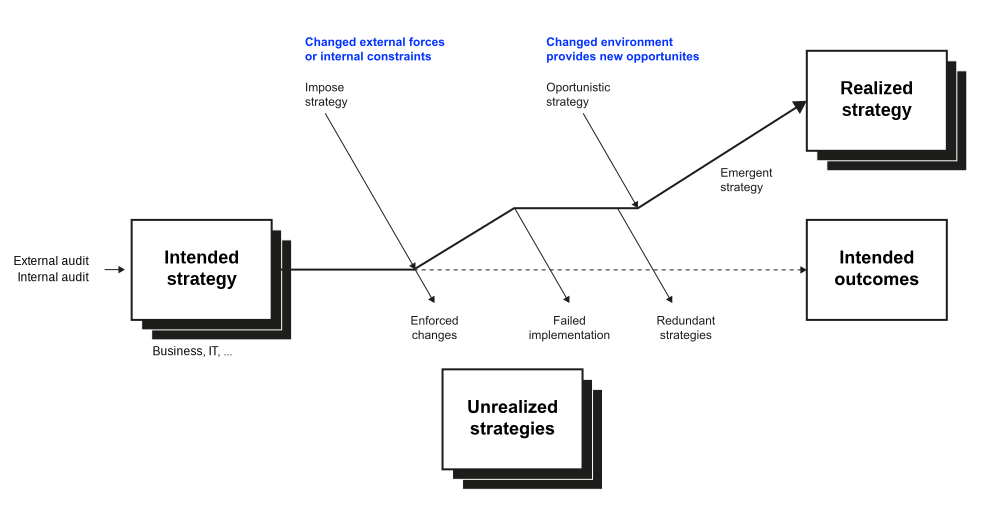
Figure 5: The emergence of IT strategy

Figure 5 shows that while at any one time a comprehensive analysis of the business and IT internal and external environments can be carried out to define an intended set of strategies, it is unlikely that all aspects of these strategies will be realized. Changes will occur in both the business and IT environments, and these will cause changes to be made to the IS part of the strategy. Also, parts of the intended IS strategy may not to be implemented successfully (i.e. projects fail or underachieve) and hence it has to be revised either in timescale or content. In addition, changes in the business or IT environments may impose constraints or open up new IS opportunities (Peppard & Ward, 2016).

An organizational approach to IS strategy formulation and IS planning increases the ability of an organization to sense and seize changes in the business and IT environments as

  1. IT emphasizes collective learning across the organization.
  2. The IS function works in close partnership with the rest of the organization, especially through having IS managers on management teams or placing IS executives on task forces.
  3. IS strategy formulation and IS planning is part of the normal business planning of the organization.

Deliverables

Main contents

Peppard & Ward (2016) suggest the following structure and contents for an IS strategy:

Purpose of IS strategy

Reasons for new or updated strategy such as key changes in business and IT context since last strategy (a strategy can simply be an update of the previous one). Preferably describing a ‘vision’ of the role and contribution expected of the digital capability and its relationship with business development and operations. If major business, organizational or technology changes are in the offing, it should describe them, the expected impact and when they will happen.

Summary of business strategy

The context for IS strategy provided by objectives and critical success factors (CSFs), business model, competitive forces and/or similar analyses, operating model, and resulting issues affecting the IS strategy.

Fields of action

  1. The arguments for new opportunities through IS (to gain advantage) and critical improvement areas (to avoid disadvantage) incl. reference to business strategy and further detailed analysis of competence issues, value chains (external and internal) and performance measures (e.g., related to the balanced scorecard) to determine the opportunity or problem areas and reasons for investment in them.
  2. Summary of opportunities/problem issues: a section for each one, explaining the application/opportunity/problem including the outline description, the rationale, potential benefits from investment, any critical dependencies and issues to be resolved (if any) in the context of an overall estimated timeframe for the investment (more detailed plans can be included if known).
    The opportunities/issues should be categorized into:
    1. strategic, high potential, key operational (and possibly support)
    2. prioritized high/medium/low based on business time scales.

Application portfolio

  1. Review of current application portfolio and status of current projects, i.e. other investments currently in hand and the overall resource implications of (a) completing outstanding work and ongoing commitments; (b) when resources are/will be available to address new work from above; (c) any critical issues requiring resolution within the existing strategy.
  2. Future application portfolio that included the output from 4 above to show the intended/potential investments, with priorities, and the implications for the rest of the portfolio (e.g. replaced applications, new infrastructure or services etc.).

Initial resource estimates (and costs) of the investments should be appended to the portfolio, with an initial ideal timeline.

Issues arising from the IS strategy

The things that require senior management attention to enable decisions affecting the strategy (priorities, resources, organization, other initiatives etc.) to be made in the required time frame.

Other topics

Peppard & Ward (2016) points out following further topics that need to be addressed by strategic IS/IT management:

  • The formal organization and resource structures plus reporting lines and the allocation of responsibility and authority for IS provision and associated decisions. This includes the roles of any steering, planning, review or other decision-making groups. The allocation of authority and responsibility indicates how much control is retained in the corporate body and how much is devolved into the business, as well as between business managers and specialists.
  • Investment approval and prioritization policies and practices: the implementation of the strategies will require many separate decisions on a variety of types of investments to be made. Rules and practices must be defined, preferably aligned to the different segments of the application portfolio (strategic, key operational, etc.) and balancing the need for financial justification and management judgement. They should state how the various expenses (including internal resource costs) and capital items (including technology depreciation) should be treated and how risks should be assessed.
    Policies and practices also need to define a mechanism aligned closely with the investment decision-making process, for priority setting and resource allocation, to ensure that the best return is obtained from the resources available. Finally, the strategy should state how the outcome of the investments and projects will be evaluated after completion.
  • Vendor or supplier policies: these should cover the relationship with specific vendors, or the parameters that must guide selection of technology suppliers and contracts with any service providers. They should also be clear as to when central approval is needed or where local decisions can be taken.
  • HR policies, including development and education of both specialists and business users and the management of changes resulting from IS implementation. It is easy to jeopardize IS strategies due to mismanagement of the people issues — new job roles and skills required, reorganization, redeployment and even redundancy. Each project, in each area, with each new technology should not need separate ‘negotiation’ – progress will become erratic and slow and outcomes uncertain, causing the strategy to be continually disrupted.
  • IT accounting policies: strategies can fail due to insensitive or inappropriate accounting policies for the costing of, or charging for, IT resources and services. The objectives of policies such as ‘IT charge back’ should be clearly stated and understood. While they initially appear to be management accounting systems for cost allocation, once implemented they become ‘transfer pricing’ mechanisms, which will influence how users make decisions.

Conclusions

Critical success factors

Developing an IS strategy is a major undertaking, and despite a plethora of so-called ‘methods’, planning tools and brigades of consultants, it is still more of an art than a science (Peppard & Ward, 2016). However, there are a number of factors that can be considered critical to success:

  • Using the ‘best’ people available from the business and IS unit (and, when necessary, external advisers) to provide knowledge of the industry, the business, the capabilities IS can deliver and, above all, creative thinking, none of which can be derived from a methodology;
  • Gaining the enthusiasm, commitment and involvement of top management;
  • Getting a thorough understanding of the internal and external business and IS environments, the business situation, its culture and the imperatives driving the strategy;
  • Setting objectives consistent with the organization’s experience and maturity and tailoring the approach accordingly, employing a mixture of analytical and creative techniques.

It should be remembered that having a good strategy is only a means to an end – its implementation is when the value of the strategy is actually realized. A key aspect of the formulation process is ensuring the organization is both willing and able to implement its chosen strategy. This will depend as much on how the strategy is derived, and who is involved, as the content of the strategy.

Review and consolidation

The following questions are designed to review and consolidate what you have learned and are a good starting point for preparing for the exam.

General questions:

  • Provide examples of how different organizational roles (e.g., IT professionals, business executives) may have varying perspectives on IS strategy. How can these perspectives be aligned to ensure strategic coherence?
  • Elaborate on the relationship between IS strategy and business strategy. How can an organization ensure that its IS strategy is aligned with and supportive of its broader business goals?
  • Discuss the impact of changes in business strategy on IS strategy and vice versa. Provide examples of how organizations can adapt their IS strategies to changes in the business environment.
  • Outline the key components of an IS strategy, including its scope, contents, and structure. How do these components contribute to the clarity and effectiveness of an IS strategy?
  • What other structures and policies are required or support the formation and implementation of IS strategy?
  • Compare and contrast the characteristics of an IS strategy document with other deliverables, such as an IT plan or technology roadmap (i.e., the outcome of IS planning). What distinguishes an IS strategy from these related documents?
  • How can organizations ensure that their investments align with strategic objectives? Discuss the role of stakeholders in the process of identifying and prioritizing IS investments. How can organizations balance the needs and expectations of various stakeholders in this context?
  • Discuss the challenges that organizations might face in implementing IS strategies and how these challenges can be addressed.
  • Imagine you are a CIO of a mid-sized company. How would you approach aligning the IT strategy with the business strategy? How would you measure the effectiveness of business-IT alignment in an organization? What metrics or indicators would you use?
  • Describe a scenario where misalignment between business and IT strategies led to negative consequences. What could have been done differently?
  • How can organizations ensure that business-IT alignment is maintained over time, especially in a rapidly changing business environment?

Questions with regards to Henderson & Venkatraman (1993) and their concept of business-IT alignment:

  • Why is achieving alignment between business and IT strategies important for organizational performance?
  • What are the four domains of strategic choice according to the Strategic Alignment Model (SAM) proposed by Henderson & Venkatraman (1993) and how do they interact?
  • Explain the dimensions of Strategic Fit and Functional Integration in the context of SAM.
  • What are potential challenges organizations might face in achieving business-IT alignment?
  • How has the concept of business-IT alignment evolved since Henderson and Venkatraman’s proposed the SAM?

Homework

  1. Read Henderson & Venkatraman (1993) and try to gain a comprehensive understanding of the business-IT alignment concept. Also do an exploratory research and try to understand how the concept has evolved.
  2. Read the case study “Sea Limited: Sustain or Expand”.

Literature

Chen, D. Q., Mocker, M., Preston, D. S., & Teubner, A. (2010). Information systems strategy: Reconceptualization, measurement, and implications. MIS Quarterly, 233–259.
Earl, M. J. (1993). Experiences in strategic information systems planning. MIS Quarterly, 1–24.
Henderson, J. C., & Venkatraman, H. (1993). Strategic alignment: Leveraging information technology for transforming organizations. IBM Systems Journal, 32(1), 4–16.
Mintzberg, H. (1987). The strategy concept i: Five ps for strategy. California Management Review, 30(1), 11–24.
Peppard, J., & Ward, J. (2016). The strategic management of information systems: Building a digital strategy. Wiley.

Footnotes

  1. IS strategy is the broader organizational perspective on information systems, while IT strategy typically refers more narrowly to the technology infrastructure and IT function planning. In practice, these terms are often conflated, and we use them interchangeably to refer to the broader perspective.↩︎

  • ⓒ Andy Weeger
Cookie Preferences
  • Start

  • About

  • HNU

  • Imprint