Power dynamics
How to exercise influence without formal authority?
Introduction
On power and politics
Many new managers erroneously believe that the “powerful” are those in more senior positions, because they equate power simply with formal authority Hill (2003, p. 272)
Power in organizations
Organizations can be seen as both, cooperative systems of employees working together to achieve goals and political arenas of individuals and groups with differing interests (Brass, 2017).
Power can be defined as the ability to get other people to do what you want them to do, politics as power in action, using a range of techniques and tactics (Buchanan & Badham, 2020).
Power and politics is at the heart of how organizations function (Hill, 2003).
Though, often associated with negative connotations, Buchanan & Badham (2020) shows that the view of the damaging, negative consequences of politics is too narrow. Politics can be both ‘functional’ and ‘dysfunctional’.
Power and leadership
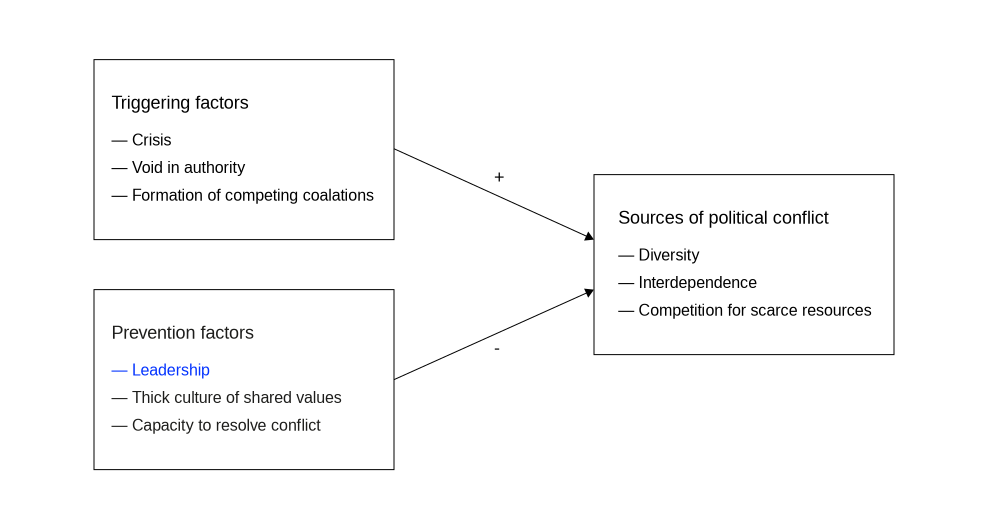
Other things being equal, political conflict increases with growing interdependence, diversity, and resource scarcity (Pfeffer, 1992).
Managers who ignore or fail to understand how power and influence work in organizations will find that they and their teams experience difficulty in being effective and ethical in their work. Hill (2003, p. 273)
Development of competing coalitions and periods of organizational crisis1 exacerbate political conflict, while leadership and shared value help to reduce the amount of conflict (Hill, 2003).
Leaders need to define a vision that aligns and motivates people, creates shared values, and a shared culture—these are critical mechanisms for managing the increased diversity and interpedendence in organizations today.
Summary
Sources of power
Discovering that formal authority is a very limited source of power, new managers must find other ways to get things done […] they soon learn that power and influence are the meachnisms by which the inevitable political conflicts in organizations get resolved. Hill (2003, p. 274)
Personal and positional characteristics
Sources of personal power (Hill, 2003, p. 276)
- Expertise: relevant knowledge and skills
- Track record: relevant experience
- Attractiveness: attributes that others find appealing and identify with
- Effort: expenditure of time and energy
Sources of positional power (Hill, 2003, p. 276)
- Formal authority: position in hierarchy and prescribed responsibilities
- Relevance: relationship between task and organizational objectives
- Centrality: position in key networks
- Autonomy: amount of discretion in a position
- Visibility: degree to which performance can be seen by others
Building key relationships
Companies are increasingly required to engage in cross-organizational work (across levels, functions, geographies) in an effort to improve their capacities to execute and innovate.
Leaders need to build and maintain key relationships to identify changes in the priorities and needs of these groups and prepare their field for new opportunities and threats—a strong, well-developed network can provide the kind of big picture information needed in today’s world (Brass & Krackhardt, 2012).
According to Hill (2003), effective leadership requires to
It is always better to overestimate rather than underestimate dependencies. Hill (2003)
Conclusion
Leadership in modern organizations extends far beyond formal authority. As you develop in your leadership journey, consider these key insights:
- Recognize that power is multifaceted — while formal authority is limited, effective leaders cultivate diverse sources of power—both personal (expertise, track record, effort) and positional (relevance, centrality, visibility). ** Embrace productive politics** — politics isn’t inherently negative but rather “power in action.” Skilled leaders engage in organizational politics functionally, using influence techniques to navigate interdependencies and resolve conflicts constructively.
- Manage organizational seams — pay particular attention to the interfaces between departments and units, as these are where political conflicts often emerge. Your ability to reduce friction at these seams directly impacts organizational effectiveness.
- Invest strategically in social capital — your network is a critical resource. Understand that the value of relationships is context-dependent—sometimes strong, cohesive ties are beneficial; other times, weak ties that bridge structural holes provide greater advantage.
- Apply the opportunity-motivation-ability framework from Adler and Kwon to develop relationships that provide access to resources, information, and support across organizational boundaries.
- Create alignment through shared values. Use your influence to foster a common vision that can overcome the natural political tensions arising from diversity and interdependence.
Remember that effective leadership requires constant attention to dependencies and relationships. As you progress, continuously reevaluate your sources of power, nurture your network, and adapt your political strategies to changing contexts. In the end, your effectiveness will be judged not by your formal position but by your ability to exercise influence across organizational boundaries.
Literature
Footnotes
Competing coalitions represent what happens when ’organizational seams’ (i.e., interfaces or boundaries between distinct units) become battlegrounds — different departments or teams develop their own agendas, priorities, and cultures - creating friction at the seams. Organizational crises can intensify these seam problems as departments protect their interests during uncertainty or resource constraints.↩︎
Dependencies can be analyzed by asking questions such as On whom am I dependent, and who depends on me?↩︎
Political dynamics can be understood by asking, e.g., What differences exist between me and the people on whom I am dependent? What sources of power do I have to influence this relationship?↩︎
Questions like What can be done to cultivate or repair the relationship? help to cultivate relationships↩︎
Social capital theory
In brief
It is not what you know,
it is who you know.
History
The concept of social capital has been relative independently introduced by scholars from various disciplines at different times.
Seminal works particularly originate from
Since the 1990s the concept of social capital found its way into organizational and management sciences to explain e.g.
Definitions
Similarities and distinctions
The definitions of social capital share some similarities and distinctions:
Strong vs. weak ties
Coleman (1988) argues that cohesion, that is to say the strength of the relationship between actors, is the source of social capital (strong ties)
Burt (2018) posits that social capital rather emerges from opportunities to bridge disconnections or non-equivalencies separating non-redundant sources of information (structural holes)
Structure, cognition, and relation
Value
The ultimate value of a given form of social capital is context-dependent (Adler & Kwon, 2002).
Strong ties
Effective search for novel information
(competitive rivalry, certain tasks, individual contribution)
Weak ties
Effective transfer of information and tacit knowledge
(collective goals, uncertain tasks, group contribution)
The value is further dependent on the availability of complementary resources (e.g., combination capability)
Opportunity, motivation, and ability
According to Adler & Kwon (2002) conceptual model, context plays a critical role in determining the value of social capital. They propose that the value of social capital is not universal or fixed but rather contingent on specific contextual factors. This contextual perspective is significant because it challenges simplistic views that social capital is universally beneficial. Instead, Adler and Kwon emphasize that the value of social capital is situational and dependent on these contextual factors, which helps explain why similar network structures or relationships might yield different outcomes in different settings.