Leader characteristics
What makes an effective leader?
The Big Five
The Big Five traits have been found to be relevant to many aspects of life, such as subjective well-being (e.g., DeNeve & Cooper, 1998) and even longevity (Friedman et al., 1995). They also provide a valuable taxonomy for the study of leadership (Judge et al., 2002).
- Openness to Experience
- This trait reflects a person’s willingness to explore new ideas, be curious, and engage with novel experiences. Those high in openness tend to be creative, imaginative, and interested in art, music, and diverse cultural experiences. They’re often intellectually curious and comfortable with abstract thinking. Those lower in openness may prefer familiarity, concrete thinking, and conventional approaches.
- Conscientiousness
- This trait describes a person’s tendency to be organized, disciplined, and achievement-oriented. Highly conscientious individuals are typically reliable, thorough, and methodical in their approach to tasks. They value planning, order, and completing responsibilities. Those lower in conscientiousness may be more spontaneous, disorganized, and might prioritize flexibility over structure.
- Extraversion
- This trait reflects a person’s preference for social interaction and external stimulation. Extraverts tend to be energetic, talkative, and gain energy from being around others. They often seek excitement and are comfortable in group settings. Introverts (those low in extraversion) typically prefer quieter environments, deeper one-on-one interactions, and need time alone to recharge.
- Agreeableness
- This trait describes a person’s tendency toward cooperation and social harmony. Highly agreeable individuals are typically compassionate, considerate, and eager to help others. They value getting along with people and avoiding conflict. Those lower in agreeableness tend to be more competitive, skeptical, and willing to challenge others’ views.
- Neuroticism (sometimes referred to as Emotional Stability)
- This trait reflects a person’s tendency to experience negative emotions and psychological distress. Individuals high in neuroticism may experience more anxiety, mood swings, irritability, and emotional reactivity. Those low in neuroticism (high in emotional stability) tend to be more calm, emotionally resilient, and less easily upset by stressors.
Relation to leadership
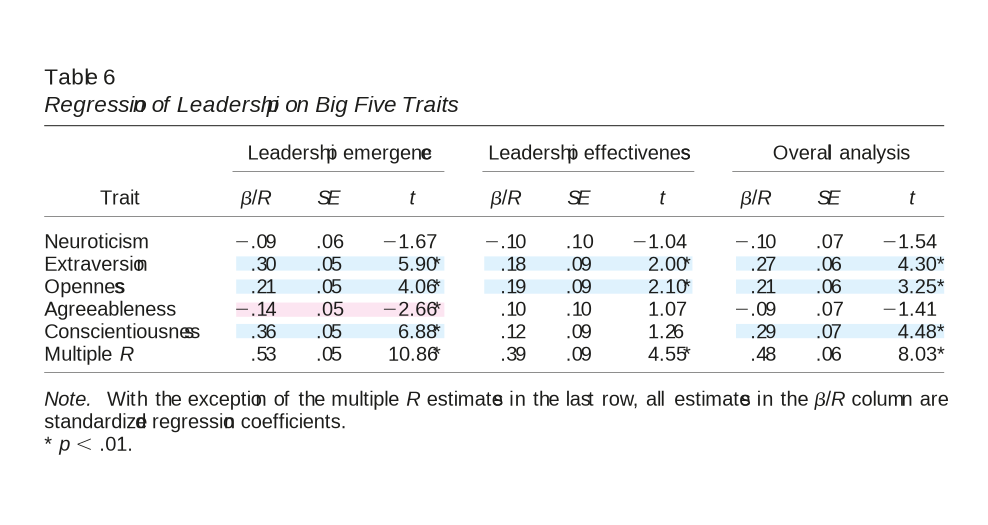
Leadership effectiveness refers to a leader’s performance in influencing and guiding the activities of his or her unit toward achievement of its goals (Stogdill, 1950).
Leadership emergence refers to whether (or to what degree) an individual is viewed as a leader by others, who typically have only limited information about that individual’s performance (Hogan et al., 1994).
Leadership effectiveness and emergence represent two levels of analysis. Leadership emergence is a within-group phenomenon. In contrast, leadership effectiveness represents a between-groups phenomenon.
Regarding these two constructs and personality trais, the meta-analysis of Judge et al. (2002) shows that:
- The Big Five typology is a fruitful basis for examining the dispositional predictors of leadership.
- Extraversion is the most important trait of leaders and effective leadership.
- Extraversion is more strongly related to leader emergence than to leader effectiveness.
- Extraversion, Conscientiousness and Openness to Experience were the strongest and most consistent correlates of leadership.
- Conscientiousness ist more strongly related to leader emergence than to leadership effectiveness.
- Agreeableness was the least relevant trait.
- Neuroticism failed to emerge as a significant predictor of leadership.
Overall, the traits are better predictors in situations in which individuals have only limited opportunity to observe leadership behaviors (i.e., student samples). However, the results may simply indicate a close correspondence between the way we see peoples personalities and our stereotypical conceptions of the characteristics of leaders.
Emergence of traits
Evolution
Leaders are born.
Really?
Traits have a genetic source and are the result of adaptive processes (Judge et al., 2009).
The statement, thus, oversimplifies a complex phenomenon that involves an interplay between genetic factors, developmental experiences, learning, and situational contexts.
Studies of identical twins separated at birth have indeed provided valuable insights into the genetic basis of personality traits, including those associated with leadership. Twin studies typically show heritability estimates of 30-60% for leadership tendencies, suggesting a significant genetic component. However, the research doesn’t support a purely deterministic “born leader” perspective for several reasons:
- Even with identical twins raised apart, the heritability of leadership traits is never 100%. Environmental factors still play a substantial role.
- Leadership comprises multiple traits and abilities (like extraversion, assertiveness, decision-making skill, emotional intelligence) that may each have different genetic influences.
- The expression of genetic predispositions often depends on environmental triggers and opportunities (gene-environment interaction).
- Leadership development research shows that many leadership skills can be learned and improved through experience, mentoring, and deliberate practice.
- Cultural and situational factors heavily influence who emerges as a leader and what leadership styles are effective.
A more nuanced view supported by contemporary research is that certain individuals may have genetic predispositions that make leadership roles more natural or appealing to them, but these predispositions require the right environmental conditions, learning experiences, and opportunities to develop into effective leadership.
“Asking how much a particular individual’s attitudes or traits are due to heredity versus the environment is nonsensical, just like asking whether a leaky basement is caused more by the crack in the foundation or the water outside.” Olson et al. (2001, pp. pp. 845–846)
The Leader Trait Emergence Effectiveness (LTEE) model
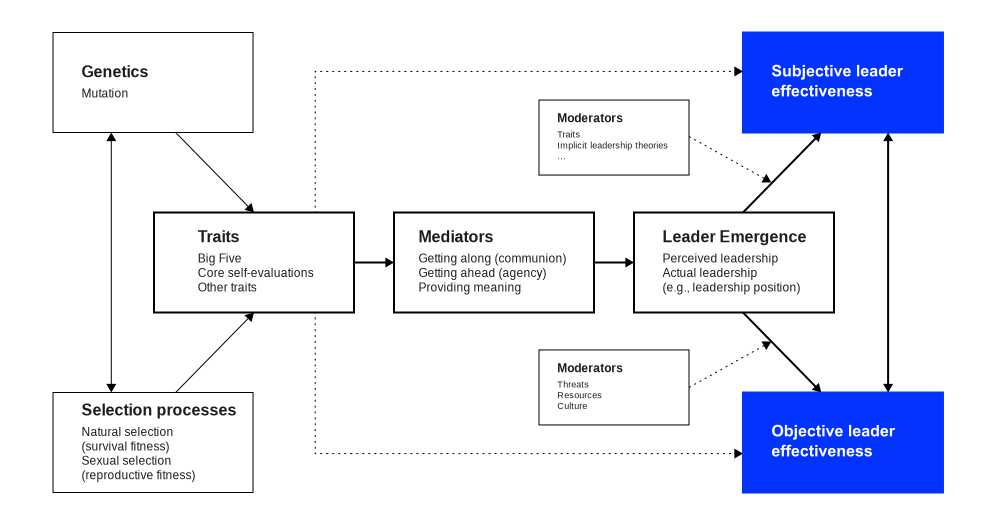
The Leader Trait Emergence Effectiveness (LTEE) model combines the behavioral genetics and evolutionary psychology theories of how personality traits are developed into a model that explains leader emergence and effectiveness (Judge et al., 2009).
- The genetics are the foundational biological basis for leadership potential. Genetic predispositions influence personality traits, cognitive abilities, emotional regulation as well as neurological characteristics that support leadership behaviors.
- Selection processes refer to the mechanisms by which potential leaders are identified and developed. While genes determine the expression of traits, evolutionary processes, in organizations and in collectives more generally, determine which traits are “selected in” and “selected out.”
- Traits are individual characteristics that contribute to leadership potential.
- Mediators are intervening factors that translate traits into leadership behaviors. Based on Socioanalytic Theory Judge et al. (2009) argue that the reason traits result in leader emergence is because of the motives the traits elicit. For example,
- conscientious, extraverted, and emotionally stable (or high core self-evaluations) individuals may be more motivated to get ahead (agency, competing)
- extraverted and agreeable individuals may be more likely to go along (communion, cooperation),
- and intelligent, and charismatic individuals may be more likely to provide meaning for their compatriots
- Leader emergence is the process of transitioning from potential to recognized leadership, which depends on the context and the adaptive processes. As adaptive and coordination problems increase, so does the importance of leadership. There is little need for prudent, courageous and flexible leadership when the collective faces little conflict from within or without. Thus, leader emergence occurs through recognition and opportunity.
- Subjective effectiveness reflects perceived leadership quality (e.g., peer receptions, follower satisfaction, reputation and social standing).
- Objective effectiveness demonstrates tangible leadership impact (e.g., team productivity, goal achievement, financial performance).
Trait paradoxes
The bright and dark side of traits
| Trait | Bride Side | Dark Side |
|---|---|---|
| Extraversion | Greater leadership emergence; higher job and life satisfaction | More impulsive (deviant) behaviors; more accidents |
| Agreeableness | Higher subjective well-being; lower interpersonal conflict; lower turnover | Lower career success; less capable of conflict; more lenient in giving ratings |
| Conscientiousness | Stronger job performance; higher leadership effectiveness; lower deviance | Reduced adaptability; lower learning in initial stages of skill acquisition |
| Emotional stability | High job/life satisfaction; better job performance; effective leadership; retention | Poorer ability to detect risks and danger; more risky behaviors |
| Openness | Higher creativity; greater leadership effectiveness; greater adaptability | More accidents and counterproductive; rebelliousness; lower commitment |
Emotional intelligence
Intelligence is the most “successful” trait in social and applied psychology (Judge et al., 2009).
Goleman (1998) argues that it is not IQ (intelligence, a trait), but emotional intelligence that sets apart great leaders.
Emotional intelligence is a group of five skills that enable the best leaders to maximize their own and their followers’ performance:
- Self-awareness — knowing one’s strenghts, weaknesses, drives, values, and impact on others.
- Self-regulation — controlling or redirecting disruptive impulses and moods.
- Motivation — relishing achievements for its own sake.
- Empathy — understanding other people’s emotional makeup and treating them accordingly.
- Social skill — building rapport with others to move them in decired directions.
Homework
Read Lavine (2014) and answer following questions:
- What is ambidexterity, what is behavioral complexity?
- Why does a complex world require behavioral complexity?
- Which leadership paradoxes are identified by the CVF?
Can you give specific examples for each? - How do the paradoxes relate to the specifics of the digital era?