Introduction
DI in Industry (DIiI)
Innovation in the digital age
Digital technologies
Digital technologies have lowered the cost of producing and disseminating knowledge.
This induces four key changes in innovation practices and outcomes across industries (OECD, 2019):
- Data are becoming a key input for innovation
- A focus on service innovation enabled by digital technologies (i.e., servitisation)
- Innovation cycles are accelerating
- Collaboration is becoming a more critical component in innovation
Data as core input
Data from a variety of sources (e.g., consumer behavior, business processes, research) are a key driver of innovation.
The exponential growth of generation of data of various kinds and the new ways of collecting and utilizing such data have made it a key input for innovation in all sectors of the economy. The development of the Internet of Things (IoT) is contributing to a steady increase in data generation as more devices and activities are connected. The use of AI, including machine learning, further increases the expected value of data (OECD, 2019, p. 27).
Data and data analytics provide opportunities for research and driving innovation, including in the following ways.
- Changing the research process
(e.g., large-scale computerized experiments and ML for vaccine development) - Enabling new products, services and business models
(e.g., on-demand-mobility services) - Enhancing customization
(e.g., marketing, precision medicine) - Guiding process optimization
(e.g., real-time supply chain systems, traceability)
Servitisation
Digital technologies are leading to a blurring of the boundaries between services and manufacturing
As data and software are replacing many physical components and products, opportunities arise in particular for the creation of entirely new digitally enabled services (e.g., predictive maintenance, on-demand transportation). New digital technologies have also propelled the expansion of sharing or renting as service models that replace selling (e.g., of equipment), and the customization of products as a service (OECD, 2019, p. 29).
Also, rising competitive pressures linked to the entry of digital players in traditional sectors and changing consumer demands, are pushing incumbent manufacturing firms to offer new digitally enabled services, while allowing service providers to improve their offerings (OECD, 2019, p. 30).
Digital technologies like data analytics capabilities, augmented and virtual reality, and IoT provide opportunities for new services and service innovations, including in the following ways.
- Enabling new complementary services (i.e., servitisation of manufacturing due, e.g., real-time monitoring of products’ status, performance and usage and growing data analytics capabilities)
- Enhancing the service experience (e.g., personalized promotions, digital mirrors, “pay as you live”)
Faster innovation cycles
Digital technologies offer new opportunities to experimentation and version and thus allow accelerating innovation cycles.
- Accelerating design, prototyping and testing (e.g., 3D printing, digital twin)
- Allowing experimenting with (not fully finished) products and services on the market (e.g., public beta, lean-start-up method)
- Enabling regular upgrading and versioning (e.g., “over the air” updates)
- Increasing the flexibility of manufacturing, enabling small series production at low cost, and allowing for higher customization (e.g., Industry 4.0. 3D printing, software-based customization)
Collaborative innovation
Innovation ecosystems are becoming more and more open and diverse.
Companies are increasingly interacting with research institutions and businesses. The reasons for this are complex. First, such collaborations provide access to a richer pool of expertise and skills that complement their own competencies. Access to talent is expected to spur creativity and enable innovation in new areas. Second, such collaborations enable the sharing of costs and risks of uncertain investments in digital innovation. Companies often face multiple potential research and technology development paths that require substantial investments with uncertain outcomes to master (e.g., the vaccine development collaborations during the Covid 19 pandemic). Finally, lower communication and collbaboration costs enable greater interaction among actors involved in innovation, regardless of their location (OECD, 2019, p. 32).
These collaborations take different forms, including the following.
- Data sharing (e.g., sharing data with supply chain partners and retailers)
- Business incubation (e.g., accelerator programs)
- Open innovation (involves collaboration with other businesses, public research and university partners, digitalization reduced the costs for open innovation partnerships)
- Platforms (e.g., open software platforms) and other innovation ecosystems (e.g., crowdsourcing platforms)
- Corporate ventures capital investments and acquisitions
- In-house collaborations (e.g., digital innovation labs or innovation garages)
Sectors
Differences
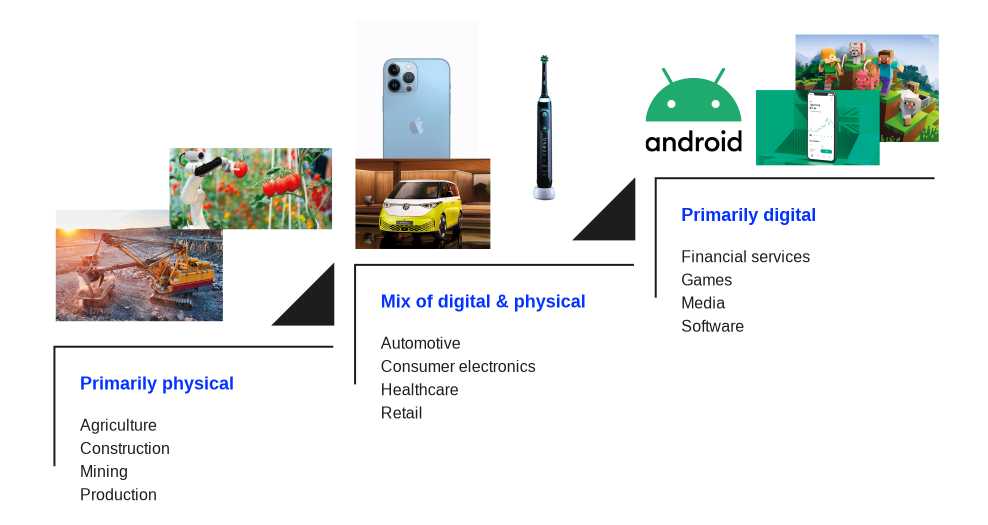
Since industries significantly differ in their products and processes, their structures, and in how they engage in innovation, the approaches and outcomes to digital innovation are unlikely to be the same.
For example, end products in primary sectors such as the food industry or mining remain largely unchanged, while the media, music and games industries have completely digitized their offerings in recent decades and healthcare innovations draw significantly on advances in AI and biotechnology. Production and innovation processes have also been transformed by digital technologies, but in different ways: while robots are used extensively in the automotive industry to automate processes, automation is still in its infancy in sectors such as agriculture and retail (OECD, 2019, p. 45).
According to OECD (2019, p. 42ff) three main dimensions shape the differences:
- The scope of opportunities for digital innovation
- The types of data needed for innovation and related challenges for exploration and exploitation
- The conditions for digital technology adoption and diffusion
Opportunities
Depending on the sectorial characteristics, digital technologies may offer different opportunities for
- creating digitalized products and services,
- digitalizing business processes, and
- establishing new digitally enabled business models.
Digitalized offerings
Digital technologies have the potential to create new or expand existing goods and services with digital features.
Digitalized processes
Digital technologies offer opportunities for
- automation of business processes,
- interconnected supply chains to increase transparency and agility, and
- improved interactions with the consumer
Digital business models
In some cases/sectors new business models largely displace incumbent ones (e.g., online booking platforms)
In other sectors they may co-exist (e.g., combined brick-and-mortar and online shopping experiences)
Examples
Let’s look at three distinct sectors and how digital innovation is changing these.
- Agri-food (production, processing, distribution and commercialization of food)
- Automotive (manufacturing, distribution, and commercialization of vehicles, as well as after-sales activities)
- Retail (selling consumer goods or services to ultimate consumers, both online and at physical stores including transportation of products from warehouses to stores and directly to customers)
Agri-food sector
Digital innovations in the agri-food sector focus on production processes and supply chain management (OECD, 2019, p. 44).
- Precision farming — using digital technologies to optimize use of inputs for crops to grow optimally (e.g., managing inputs like water, fertilizers, pesticides)
- Introduction of robots (e.g., for fruit-picking, harvesting and milking)
- Big data analytics & AI to inform farm management decision-making (Wolfert et al., 2017)
- Potential to trace products along supply chains using IoT and blockchain technology (Shahid et al., 2020)
| Innovation | Data needs | Challenges |
|---|---|---|
| Precision farming | Aggregated sensor data from many farms (fields, machinery, drones, satellite data) |
|
| Product traceability | Product-level sensor data (origin, processing stages, actors involved, transportation and storage conditions) |
|
Automotive industry
Digital innovations are completely reshaping the automotive sector including the products, production, and business models.
- Connected cars and value-add services (e.g., automatic emergency, real-road hazard warnings, car repair diagnostic, networked parking)
- Autonomous cars and driving assistance systems
- Alternatives to car ownership (e.g., vehicle subscription services, car-sharing services, ride-hailing platforms)
- Smart factories using IoT & robotics in production processes
| Innovation | Data needs | Challenges |
|---|---|---|
| Conected cars | Sensor data from cars and infrastrucutre, GIS, real-time traffic information, etc. |
|
| Optimization of value chain processes_ | Production and processing data along the supply chain, real-time demand data |
|
Retail sector
In the field of retail, digital innovations aim at enhancing the consumer experience and optimizing processes.
- Big data analytics for customized and targeted marketing
- Enhanced online and physical shopping experience (e.g., smart dressing rooms, automatic payment systems, 3D visualization)
- IoT and robotics for better inventory management
Diffusion trends
Differences between sectors
The level of digital technology adoption varies across sectors (Calvino et al., 2018).
Differences in adoption rates stem from variances in sectors’ capabilities and incentives to adopt new technologies (Andrews et al., 2018).
Key factors influencing adoption include
- Individual and organizational capabilities
- Presence of market disruptors (e.g., digital start-ups or tech firms)
- Sectoral characteristics (e.g., access to relevant infrastructure)
- Consumer demands and attitudes towards change
Distribution of firm size and sectoral fragmentation: large firms have usually the resources to adopt new technology, while small firms are more risk-averse. On the other hand, large firms can suffer from inertia, rigid hierarchical structures, and legacy systems that may hamper the diffusion of digital innovations. Technology diffusion may also be slower in highly fragmented sectors.
Access to relevant infrastructure: this might be a challenge for sectors and firms located in more remote or rural areas.
Complexity of supply chains: tight connections among firms along the supply chains also influence dynamics of innovation diffusion — suppliers may adjust more rapidly upon requests from upstream partners.
Level of public investments: the public sector is the main (direct or indirect) provider of services such as education and healthcare. Thus, the level of diffusion depends on the capacity of the pbulic sector to invest in these areas.
Technology lifecycle
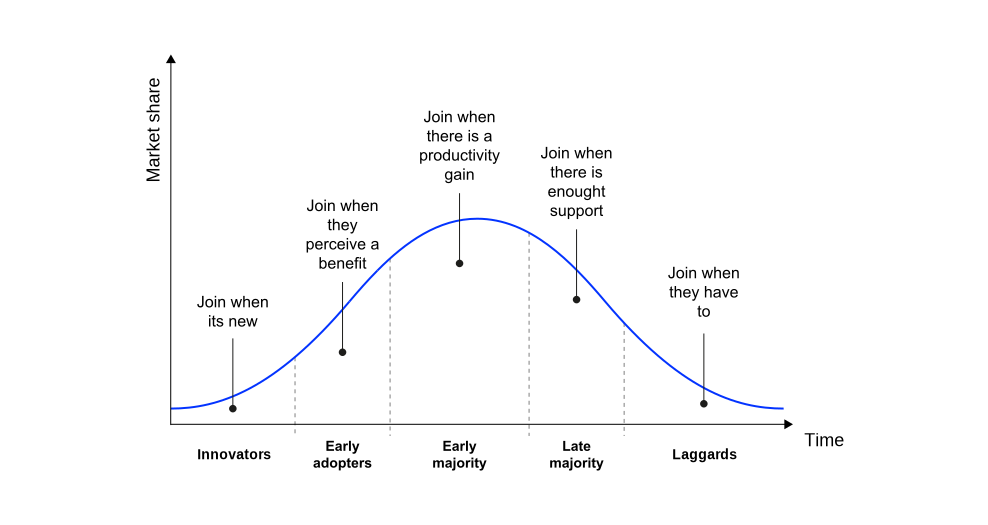
Rogers (1962) introduced the technology lifecycle to describe the diffusion of innovations, which follows this progression:
- Innovators — technology enthusiasts who embrace new technology first
- Early adopters — visionaries who see strategic advantage in new technology
- Early majority — pragmatists who want proven solutions
- Late majority — conservatives who adopt only when necessary
- Laggards — skeptics who avoid new technology
Cross the chasm
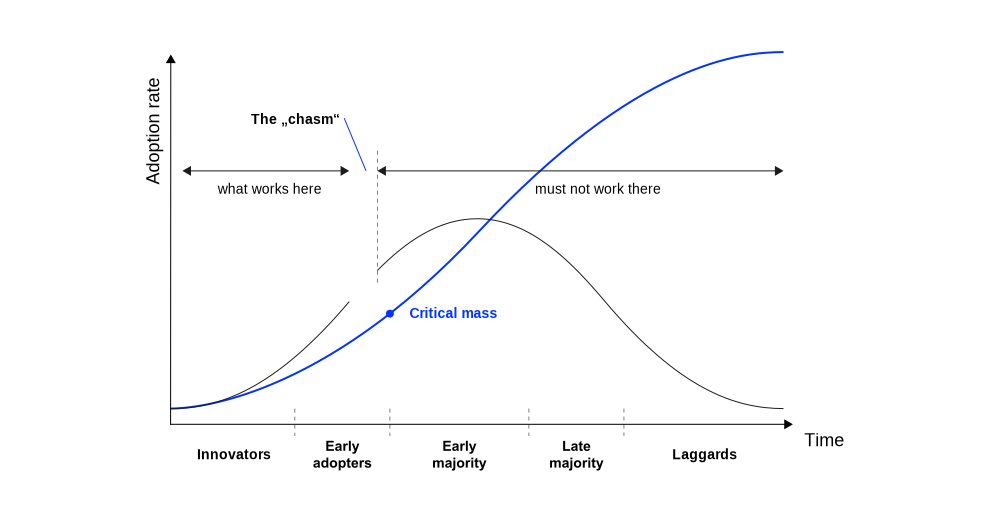
What makes crossing the chasm so challenging is that the strategies that work for early markets often fail in mainstream markets, as mainstream markets differ substantially for several key reasons:
Different buyer motivations
- Early adopters (visionaries) seek revolutionary change and competitive advantage. They’re willing to tolerate incomplete products.
- Early majority (pragmatists) seek evolutionary improvement and risk reduction. They want complete, proven solutions.
Reference requirements
- Early adopters make decisions based on technology and future potential.
- Pragmatists need social proof - they want to see others like them successfully using the product.
Support expectations
- Early markets accept minimal support as part of being on the cutting edge.
- Mainstream markets demand comprehensive support infrastructure.
Product completeness
- Early adopters accept core technology with gaps they’ll fill themselves.
- The early majority requires a “whole product” solution - the core product plus everything needed to achieve their desired outcome.
Sales approach
- Selling to visionaries requires executive-level relationships and focuses on strategic potential.
- Selling to pragmatists requires industry-specific expertise and focuses on operational improvements.
Pricing models
- Early adopters often pay premium prices for strategic advantage.
- Mainstream markets expect more standardized, value-based pricing.
These fundamental differences mean companies must essentially transform their entire go-to-market strategy - from product development to marketing messaging to sales channels - to successfully cross the chasm. Making this transition is particularly difficult for startups with limited resources who must maintain their existing early-adopter business while simultaneously building a completely different approach for mainstream markets.
Evaluation of innovation
Strategic leaps
The key to getting beyond the enthusiasts and winning over a visionary is to show that the new technology enables some strategic leap forward, something never before possible, which has an intrinsic value and appeal to the nontechnologist. Geoffrey Moore, American organizational theorist, management consultant, and author
Effects of innovations
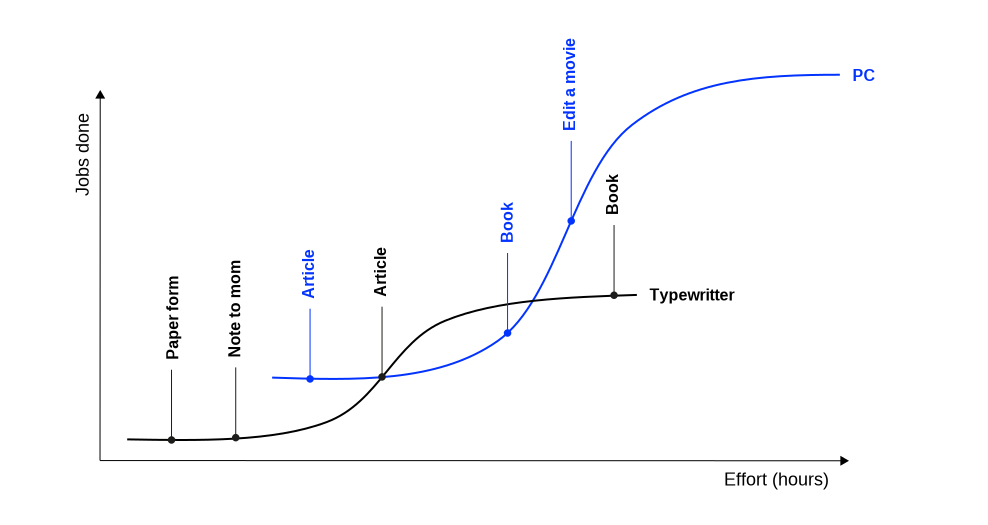
The S-curve describes the return (advancement, progress, functionality, etc) on investment (total applied effort, time, money, etc).
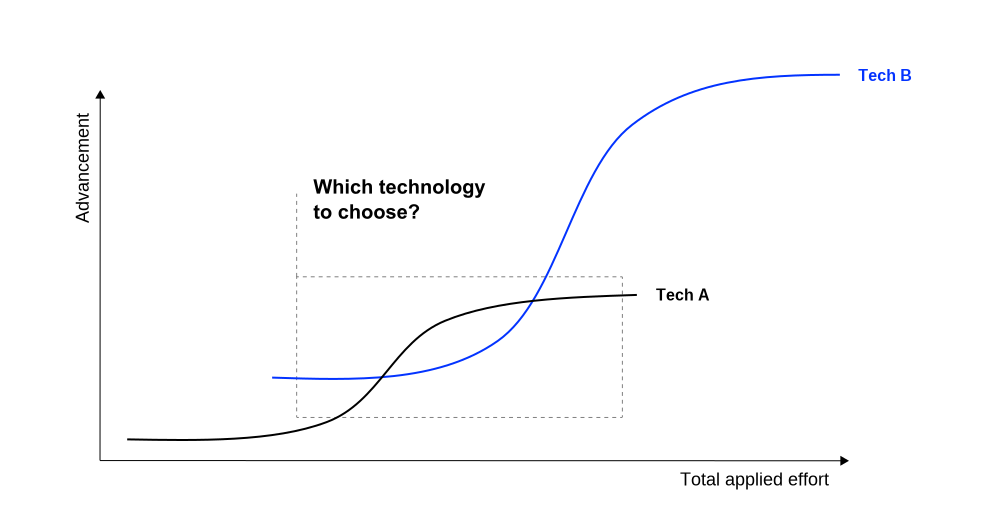
Example: typwriter vs. PC
Success criteria of innovations
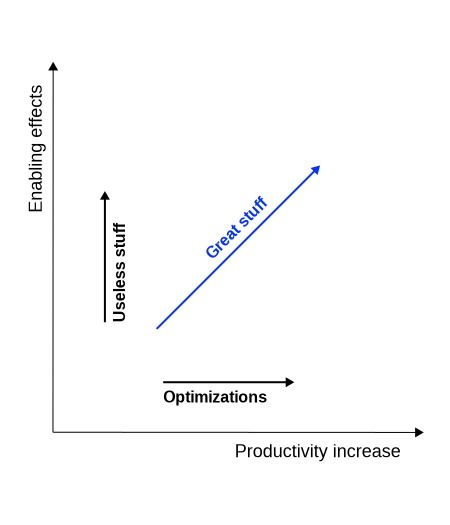
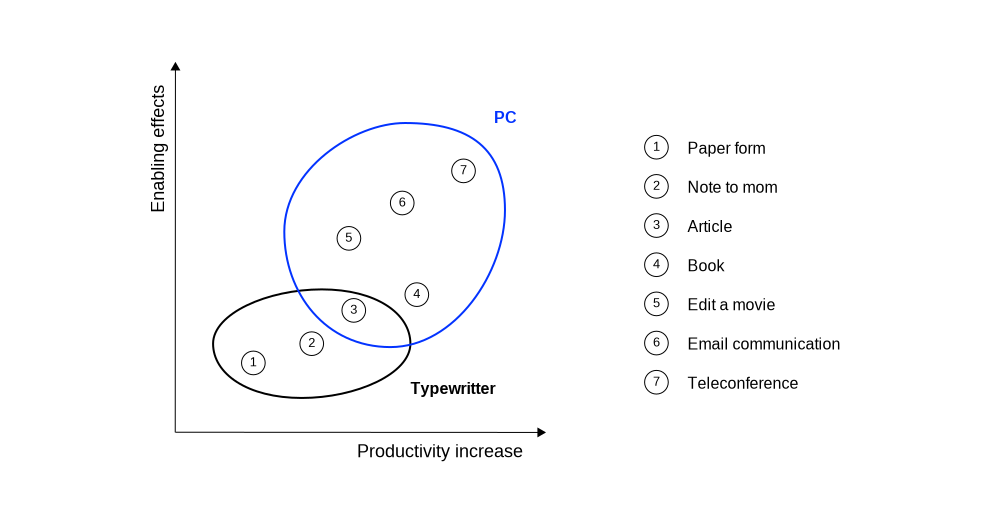
Successful innovations …
- increase productivity and
- make something possible, that was not possible before (innovation)
Example: typwriter vs. PC
Data-oriented innovation
Patterns
Besides competency-based, customer focused and externally-oriented approaches, managers can also take a data-oriented approach to systematically tackle business innovation.
Parmar, Mackenzie, et al. (2014) identified five distinct patterns that answer following question:
How can we create value for customers using data and analytic tools?
Augmenting products to generate data
Because of advances in sensors, wireless communications, and big data, it is now feasible to gather and crunch enormous amounts of data.
Those data can be used to improve the design, operation, maintenance, and repair of assets or to enhance how an activity is carried out.
Examples: SKF’s intelligent bearings, “pay-as-you-life” insurances
- Which of the data relate to our products and their use?
- Which data do we now keep and which could we start keeping?
- What insights could be developed from the data?
- How could those insights provide new value to us, our customers, our suppliers, or our competitors?
Digitizing assets
Over the past two decades, the digitization of music, books, and videos has turned the entertainment industry on its head, introducing new models such as music and video streaming.
Digitization has typically reduced distribution costs, making the ability to efficiently transport physical inventory or secure low-cost warehouse locations less relevant.
Also regarding the operation of the digital services, company can realize economies of scale and decrease time-to-market by moving the business to the cloud.
Examples: Disney Plus, 3D printed spare parts.
- Which of our assets are either wholly or essentially digital?
- How can we use the digital nature of assets to improve or augment their value?
- Do we have physical assets that could be turned into digital assets?
Combining data within and across industries
Data across supply chains and allied industries has been uncoordinated.
Big data, along with new IT standards and APIs allow enhanced data integration.
This enables coordination across industries or sectors in new ways.
Examples: smart cities, integrated supply chains, electronic health record.
- How might our data be combined with data held by others to create new value?
- Could we act as the catalyst for value creation by integrating data held by other players?
- Who might benefit from this integration and what business model might make it attractive to us or our collaborators?
Trading data
The ability to combine disparate data sets allows companies to develop a variety of new offerings for adjacent businesses.
Seemingly useless data could be a gold mine for some other business.
Data marketplaces facilitate the exchange of data.
Examples: Quandl
- How could our data be structured and analyzed to yield higher-value information?
- Is there value in the data to us internally, to current customers or to potential new customers?
- Is there value in the data to other industries?
Codifying a distinctive service capability
Companies that have perfected their business processes and systems can standardize them and sell them to other parties.
Cloud computing has put such opportunities within close reach, as it allows companies to easily distribute software, simplify version control, and offer customers “pay as you go” pricing.
Examples: AWS, Trumpf XETICS Lean
- Do we possess a distinctive capability that others would value?
- Is there a way to standardize this capability so that it could be broadly useful?
- Can we deliver this capability as a digital service?
- Who in our industry or other industries would find this capability attractive?
Homework
Kavadias et al. (2016) identified six features that characterize successful innovation, which link a recognized technology trend and a recognized market trend.
Read the paper, understand the trends and features and link them to the industries you are interested in.