Agility
DI in Industry (DIiI)
Motivation
Agile organizations are both stable and dynamic at the same time. They design stable backbone elements that evolve slowly and support dynamic capabilities that can adapt quickly to new challenges and opportunities. McKinsey & Company
Introduction
What is agile?
The term agility has been increasingly used in management literature since the late 20th century (Harraf et al., 2015).
Around the same time, agile approaches gained prominence in software development, leading to the publication of the agile manifesto in 2001 (Beck et al., 2001).
Over the past two decades, organizational theorists have focused extensively on how agile performance enable companies to successfully adapt to rapidly changing and unpredictably disruptive environments (see e.g., Adler et al., 1999; Grewal & Tansuhaj, 2001; Judge & Miller, 1991; Smith & Lewis, 2011).
Common themes
Several common themes in literature Harraf et al. (2015) have identified:
- A specific set of organizational sense-response actions that are typical for organizations operating in an environment characterized by turbulence, unpredictability, and rapid change (i.e., VUCA environments).
- Agile organizational sense-response actions can be specified using a bi-dimensional concept of magnitude of variety change1 (flexibility) and rate of generating variety change2 (speed).
- Agility is a function of environmental conditions (the industry), exhibiting varying levels of market turbulence, competitive intensity, and customer need heterogeneity.
- The likelihood of observing a positive effect of agility on performance (e.g., efficiency, innovativeness) is greater in fast-changing environments.
Towards a definition
Literature suggests that organizational agility can neither be reduced to a singular dimension nor is it appropriately calibrated in absolute terms. In terms of the four key points outlined before, organizational agility can be formally defined as follows:
It is the ability of a firm to sense and respond to the environment by intentionally changing (1) magnitude of variety and/or (2) the rate at which it generates this variety relative to its competitors (Harraf et al., 2015).
It is a firm’s ability to sense changes in its environment (like customer preferences, new technologies, etc.) and respond effectively and intentionally by adjusting what it does.
More specifically, it can do this in two main ways:
Changing the magnitude of variety
This means increasing or decreasing the range of products, services, strategies, or approaches the organization offers.
Low magnitude changes:
- A restaurant adding seasonal menu items while keeping their core menu intact
- A textbook publisher releasing updated editions with minor revisions
- A software company implementing small interface improvements through regular updates
Medium magnitude changes:
- A smartphone company introducing a “pro” version of their standard phone with enhanced features
- A bank introducing mobile banking alongside traditional services
- A manufacturer implementing flexible production techniques to customize products
High magnitude changes:
- Amazon’s evolution from online bookstore to global marketplace, cloud services provider, and entertainment studio
- Apple’s pivot from computers to revolutionizing the music industry with iPod/iTunes, then transforming mobile communications with the iPhone
- Netflix transitioning from DVD rentals to streaming to original content production
Changing the rate at which it generates this variety
This refers to how quickly an organization can adapt and innovate.
Example: If competitors are launching new products every year, and your company starts doing it every six months, you’re increasing your rate of generating variety.
The key idea is intentional adaptability—being able to sense what’s happening in the environment and deliberately adjusting how much variety and how fast you produce it, especially in comparison to competitors. Agility is not just about being flexible—it’s about being strategically responsive.
Visualization
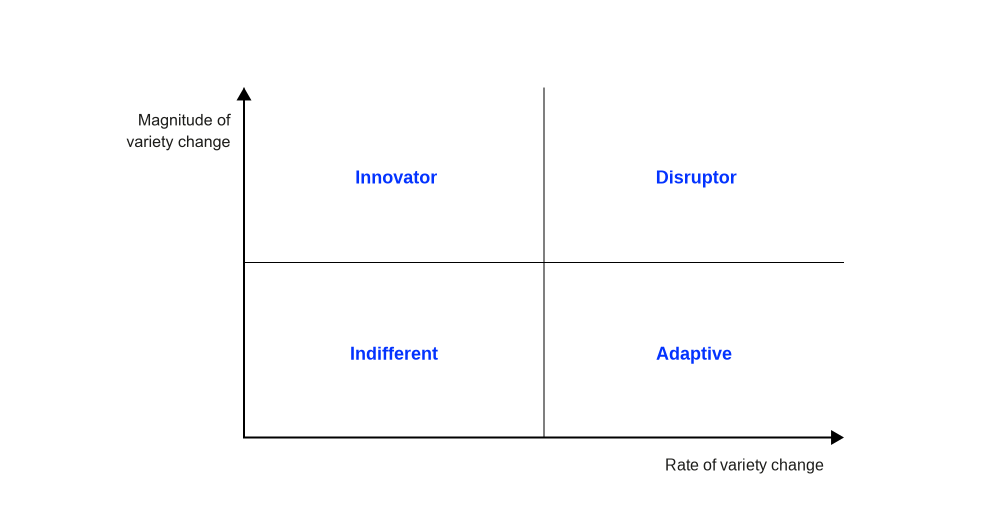
According to Harraf et al. (2015) four classes of organizations with different competitive strengths and capacity regions for agility can be identified as innovators, disrupters, adapters, and indifferents.
Innovators identify their competitive strength in being able to identify new opportunities and strive for the ability to make movements that involve a greater degree of variety change, but at the expense of a lower or constant rate of change. They are able to respond to unfamiliar changes in the environment with great diversity.
Adapters their competitive advantage in generating a higher pace of variety change while maintaining a lower or constant level of variety change. They have a constant willingness to address change quickly, proactively or reactively.
Disrupters redefine market competition by developing capacity to overcome trade-offs by generating both higher magnitude and greater rate variety change. These organizations explore and exploit opportunities for innovation and competitive performance—they move the efficiency/flexibility tradeoff to simultaneously pursue both.
Indifferents do not engage in agile based competition in the industry and they do not anticipate the magnitude or rate of variety change to be important properties of their strategic responses.
Ambidexterity and agility
In general, ambidexterity refers to the combination of both incremental, more efficiency-oriented innovation (i.e., exploitation) and radical, novelty-oriented innovation practices (i.e., exploration) (Clauss et al., 2021).
Operational ambidexterity “relates to a firm’s dual capacity to simultaneously pursue not only the implementation of disruptive ideas [… ] but also the enhancement of the firm’s current operational speed, reliability, and cost” (Lee et al., 2015, p. 401).
IT ambidexterity relates to “the ability of firms to simultaneously explore new IT resources and practices (IT exploration) as well as exploit their current IT resources and practices (IT exploitation)” (Lee et al., 2015, p. 398).
Lee et al. (2015) shows that IT ambidexterity enables operational ambidexterity, which enhances organizational agility.
Agility through IT
IT competences and digital options
IT competence describes a company’s ability to gernate IT-related innovations by means of available IT resources and the ability to translate these resources into strategic digital options (Sambamurthy et al., 2003).
Digital options are a set of IT-enabled capabilities in the form of digitized enterprise work processes and knowledge systems (e.g., digital process capital3 and digital knowledge capital4) (Sambamurthy et al., 2003).
IT competences and digital options represent organizational capabilities that are developed over time through a series of linked strategic decisions about investments in IT.
These organizational capabilities enable organizational agility.
Types of agility
Types of agility supported by IT as identified by Sambamurthy et al. (2003):
- Customer: Ability to co-op customers in exploration and exploitation of innovation opportunities (source, co-creators, testers).
- Partnering: Ability to leverage assets, knowledge, and competencies of suppliers, distributors, contract manufactors and logistics providers in the exploration and exploitation of innovation opportunities.
- Operational: Ability to accomplish speed, accuracy, and cost economy in the exploitation of innovation opportunities.
Agile IT project management
The approach to IT project management defines how IT resources are developed, orchestrated, and, best case, translated into strategic digital options.
The foundation of methods to agile IT project management is the agile manifesto (Beck et al., 2001), which defines following key values and principles:
- Individuals and interactions over processes and tools
- Working software over comprehensive documentation
- Customer collaboration over contract negotiation
- Responding to change over following a plan
These key values and principles aim to enable organizations to better deal with rapid changes in customer demands, markets and technology by, e.g., decreasing lead-time, increasing change rate, and the degree of variety change.
Agile at scale
Introduction
Agile project management methods were originally designed for use in small, single-team projects (Boehm & Turner, 2005).
Compared to small projects and teams, large projects and organizations require additional coordination (i.e., inter-team coordination)
In addition, adopting agile at scale often requires tradeoffs as interacting with organizational units that are often non-agile in nature is required (e.g., HR) and/or a change of the entire organizational culture (Misra et al., 2010) .
Another key challenge is that management must move away from traditional hierarchical models (e.g., lifecycle-based) to autonomous, iterative models (e.g., feature-based), which requires a change of mindset.
Definition
Dikert et al. (2016) define large-scale as software development organizations with 50 or more employees or at least six teams.
All people do not need to be developers, but must belong to the same organization and develop a common product or project, and thus have a need to collaborate.
This definition includes both software development companies and as the parts of larger (non-software) organizations that develop software (i.e., the application development unit within corporate IT).
Transformation challenges
Dikert et al. (2016) identified challenges in nine cateogires for large-scale agile transformations
- Resistance to change (e.g., general resistance, management resistance)
- Lack of investment (e.g., lack of coaching, training, adapting physical spaces)
- Difficulties of implementation (e.g., lack of guidance, poor customization)
- Coordination challenges in multi-team environment (e.g., interfacing, autonomous team model, technical consistency)
- Different approaches (e.g., different interpretations, old and new side by side)
- Hierarchical management and organizational boundaries (e.g., silos kept, old-styled management)
- Requirements engineering challenges (e.g., gap between long and short-term planning)
- Quality assurance challenges (e.g., lack of automated testing)
- Integrating non-development functions (e.g., adjusting to incremental delivery pace)
Frameworks
To adress challenges to adopting agile methods in large, more traditional organizations, several agile scaling opportunities have been created (Dikert et al., 2016; Uludağ et al., 2021, 2022).
Examples
| Short name | Long name/topic | Publ. year | Cur. year | Stand. org. |
|---|---|---|---|---|
| LeSS | Large-Scale Scrum | 2013 | 2015 | The Less Co. |
| Nexus | Scaling Scrum | 2015 | 2018 | Scrum.org |
| SAFe | Scaled Agile Framework | 2011 | 2020 | Scal. Ag., Inc. |
| Spotify | Scaling agile | 2014 | 2014 | Spotify |
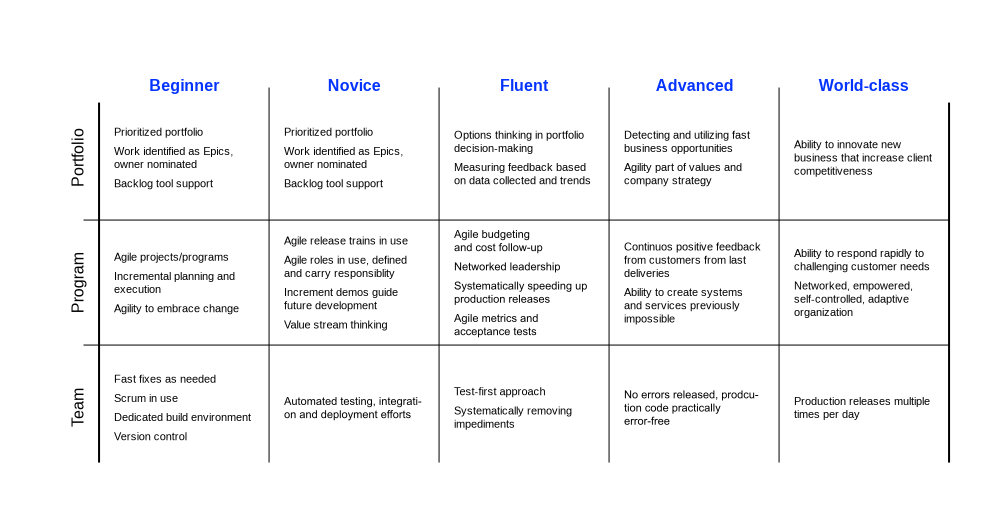
Maturity
Literature
Footnotes
Magnitude of variety change includes the decision alternatives generated, different strategies deployed, new products and lines introduced, non-routine tasks added to the repertoire of routine tasks, and product variations offered.↩︎
Rate of variety change—defines the temporality of change and relates to the change in variety per unit of time.↩︎
Digital process capital is the IT-enabled inter- and intra-organizational work processes for automating, informating, and integrating activities (e.g., customer akquisition, order fulfillment, supply chain, product innovation, and manufacturing flow) and creating a seamless flow of information (Sambamurthy et al., 2003, p. 247).↩︎
Digitized knowledge capital is the IT enabled repository of knowledge and the systems of interaction among organizational members to generate knowledge sharing of expertise and perspectives (Sambamurthy et al., 2003, p. 247).↩︎