Structure & story
Academic Writing (AW)
Opening remarks
Motivation
When developing or revising the structure for your own paper, remember that a good option is always to follow as closely as possible the standard paper structure instead of inventing new structures. Innovative structures are not always well received in the academic community because the novel structure makes reading the paper more difficult. Recker (2021b, p. 178)
Research types
Regarding you master thesis, there are basically two approaches you can take:
behavioral science or
design science.
Behavioral science
- Development of a research model or assumptions based on theoretical considerations of literature
- Empirical test of the research model
- Derivation of management recommendations
Design science
- Development of an artifact based on the body of knowledge (practice and theory)
- Empirical test of the artifact
- Refinement and repetition of the empirical test until the artifact is sufficient for management recommendation
Polarities
Following table contrasts the approaches
| Behavioral science | Design science | |
|---|---|---|
| Ontological temporality | Existing reality | New reality |
| Basic aim | Truth | Utility |
| Study focus | Behavior | Designed artifacts |
| Basic procedure | Data collection | Creation through design |
| Basic epistemic types | Explanation & description | Prescription through design principles and design theory |
| Type of conjecture | Causality hypothesis | Design idea & design hypothesis |
Structure
Why structue matters
Science is about new ideas in old formats.
Reviewers and readers are accustomed to certain ways of reading an article—the so-called “script” (Grover & Lyytinen, 2015).
Innovative structures are not always well received by scholars because the novel structure makes the paper difficult to read.
An innovative structure distracts from the content, forces readers to focus more on the structure, which gives them less capacity to focus on the content (Recker, 2021b).
Thus, a good advice is to follow the script and make only mindful variations.
Generic paper structure (empirical papers)
| Section | Content |
|---|---|
| Introduction | Problem statement, research gap, research question (RQ), approach, contributions |
| Background | Literature on the topic, research gap, general theory |
| Theory | Assumptions, propositions, hypotheses |
| Methodology | Sampling, data collection and analysis methods, etc. |
| Findings | Descriptive results of the data analysis |
| Discussion | Answer to the RQs, theoretical and practical contributions, limitations, further research |
| Conclusion | Closing frame |
Generic paper structure (design science papers)
| Section | Content |
|---|---|
| Introduction | Problem statement, research gap, research question (RQ), approach, contributions |
| Background | Research context and literature on the topic (what is known about the artifact) |
| Justification | Theory from IS and natural and social science that informs the design theory |
| Methodology | Description of the design science research approach |
| Specification | Meta-requirements, principles of implementation/process, testable design properties |
| Instantiation | Description of the artifact/system/method |
| Evaluation | Test of the artifact/sytem/method |
| Discussion | Theoretical and practical contributions, limitations, further research |
| Conclusion | Closing frame |
Examples
| Generic structure | Quantitative study: Adam et al. (2023) |
Qualitative study: Strich et al. (2021) |
Design Science: Recker (2021a) |
|---|---|---|---|
| Introduction | Introduction | Intro | Introduction |
| Background | Related literature and theoretical background | Theoretical background | Research context |
| Theory | Research model and hypotheses development | - | Solution objectives |
| Methodology | Research methodology | Research setting and methodology | Research approach |
| Findings | Study 1: Randomized field experiment Study 2: Randomized online experiment |
Findings | Evaluation |
| Discussion | Discussion | Discussion | Discussion |
| Conclusion | - | Concludsion | Conclusion |
Macro-structure (empirical papers)
The structure of many empirical papers can even be further abstracted to a macro-structure
| Section | Associated headings |
|---|---|
| Theoretical front end |
|
| Method |
|
| Implications |
|
Introduction
Function
Capture the reader’s curiosity and set the right frame (Kane, 2022).
The expectations of the readers are set here.
Motivation
Motivate your research with a hook, not a gap.
The gap is usually the argument that something hasn’t been done yet. Necessary, but not sufficient as some things shouldn’t be done (Grant & Pollock, 2011).
The hook is a strategy to find a problem that someone cares about (Grant & Pollock, 2011).
- It resolves a contradiction in the literature,
- expands the literature to include specific, important phenomena/understandings/contexts (and why)
- resolves a puzzle for practitioners that is important but not yet addressed; and/or
- demonstrates how the existing literature can mislead our thinking
Forumula
Based on Baird (2021) and Recker (2021b) following “script” can be derived:
- Paragraph 1 – Hook
What is the context of this research? Why is it interesting or why does it matter? - Paragraph 2 – Background
Synthesis of research relevant to your area, target audience, and objective. - Paragrpah 3 - Tension
What is unresolved? What am I going to get wrong if I don’t read this paper? - Paragraph 4 – Resolution
How is this paper going to resolve this issue? (objective, theory, and design) - Paragraph 5 – Contribution
What is the expected contribution? - Paragraph 6 – Outline
How is the rest of the paper structured?
Background
Function
This section provides everything needed to understand your research processes and results.
Here you lay the foundation of your theory.
The background is not a recapitulation, listing, or critique of all other work in this area, nor is it a list of concepts, it introduces and synthesizes the theoretical underpinnings you will rely on (Baird, 2021):
- relevant prior theory, assumptions and tensions,
- concepts that you need; and
- previous methods, algorithms, findings, and arguments on which your work is based.
- Organize the section according to topics, not as a list of studies.
- Discuss related work, rather than just listing it.
- Explain how your work complements others’ work.
- Explain how your work contradicts previous work.
- Highlight areas in which your work builds on others’ work. Keep it concise.’
- In the last section, briefly summarize everything by highlighting what is known, but also what is either not known or assumed and needs to be revised (in this paper).
Theory
Function
This is not where existing theory is discussed, but where the magic happens (Recker, 2021b):
Here you develop new theory.
- Provide an overview of the conceptual or research model that is being developed and strong argument for the hypotheses (i.e., constructs and their relationships)
- Keep your hypotheses simple but precise
- In an exploratory research (mainly qualitative), outline your theoretical sensibility and possibly initial assumptions that guide the research.
- Start with an overview of conceptual or research model being developed.
- Discuss components of the model in paragraphs with relevant subheadings that reflect the model.
- Follow a disciplined structure that moves from concepts to associations to laws to boundaries.
- Each hypothesis must be preceded by a strong argument as to why it should hold.
- Explain concepts or constructs in tables
- Differentiate between conceptual level (abstact) and empirical level (operationalization)
- When developing hypotheses, do not use words like “prove” but use words like “suggest” or “support.”
Methods
Function
This section provides the first part of your resolution.
Here you show how the research was carried out.
- Outline and justify your research strategy;
- provide materials, case sites, scope of survey, appropriate samples, participant selection and all other decisions related to the research design;
- describe the measurements (quantitative) or data collection techniques (qualitative) used; and
- exhibit the data analysis techniques used in your research.
- Experiment paper: experimental design, variables and measures, materials, tasks, procedures, and participants.
- Quantitative paper: design, measures, sampling strategy, procedures, and validation of measures.
- Qualitative paper: empirical setting, modes of data collection, and processes and techniques employed in data analysis.
- Design science papers: overview, meta-requirements or design principles, artefact description, and evaluation.
Findings
Function
This section describes the second part of the resolution—the evidence gathered (Baird, 2021).
Here you show what you have found out.
- Offer a description of findings (factual result reporting, past tense)
Exclude data do which the discussion will not refer and vice versa - Include appropriate statistical tests or other analyses
Keep writing, statistics, and graphs should as simply as possible
- Stick to the facts—do not include a discussion or interpretation of the findings
This section is easy to write and quite methodical—check published papers that use similar methods
Discussion
Function
This section is all about the contributions and implications.
Here the paper becomes most interesting.
- It usually starts with a summary of the main findings.
- Then proceeds with their interpretation (sensemaking, present tense):
What do they actually mean? Why did you get the results that you obtained? - Explain results: why did you find what you found?
- Abstract the results to concepts: what does it mean in a larger view?
- Theorize the results: what do they tell us about the existing/new theory?
Note: Some readers tend to skim papers, read the intro, take a glimpse on figures and tables and then devote their attention mostly to this section.
Formula
Start with reminding the reader of the area of focus and the tension (Baird, 2021).
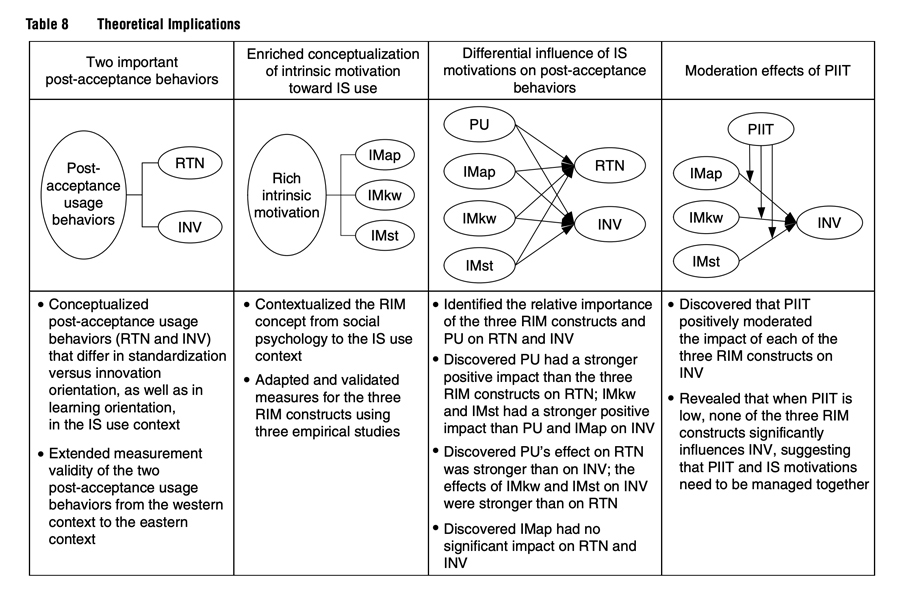
Implications for research (theoretical contributions)
- Start with the primary finding, explain how it relates to prior research, and the implications.
- Add secondary findings, as well as how they extend research, and implications.
Questions that could guide your identification of theoretical contributions:
- What did we find that can guide future research?
- What opportunities for future research arise from the study described?
- What new questions arise from the way the research question was answered in the paper?
Implications for practice (practical contributions)
- How might your primary finding be applied by practitioners?
- How about your secondary findings?
Limitations and future research
- Reiterate strengths and identify limitations (to validity, generalizability, etc.)
- Show opportunities for future research
Visualization
Implications should be visualized to enhance understanding and make them catchy.
Conclusion
Function
This section is optional and provides the closing frame to a paper (Recker, 2021b).
Here you synthesize what you set out to do and accomplished.
- The conclusion is often not much more than an abstract statement;
- it briefly summarizes the main contributions of the paper (no details) and
- reflects on the research findings presented in the paper.
Homework
Please read the hypothetical AoM micro submission “Responses to Transformational Leadership: Are Some Followers Immune?”.
Reflect on the quality of this submission based on your learnings in IS research and this module so far. Write down strenghts and weaknesses of the paper.
Then read the sample reviews and compare these with your assessment.
Imagine you are the editor deciding about accepting or rejecting the manuscript:
What recommendations would you give the authors?
Literature
Footnotes
Say only what the reader needs to know to understand the work at hand↩︎
Introductions in articles should be no longer than 2.5 pages (Baird, 2021)↩︎