Competition and Positioning
Strategy and Performance Management
Neu-Ulm University of Applied Sciences
August 18, 2026
Agenda
- Recap & objectives 10 min
- External audit, PESTEL & Five Forces 30 min
- Exercise: GenAI industry 20 min
- Megatrends 10 min
- Break 15 min
- Positioning frameworks 30 min
- Exercise: positions & schools 15 min
- Trade-offs 10 min
- Excursus: climate change 20 min
- Wrap-up & Q&A 10 min
Recap
Think briefly about the contents of our last class, then let’s discuss.
- Name the four value-stick levers and give one example of each.
- Pick one of Mintzberg’s 5 Ps and name the school of strategy most closely associated with it.
- State in one sentence why operational effectiveness alone does not create competitive advantage.
05:00
Learning Objectives
After this section, you should have a solid understanding of
- the nature and purpose of an external audit in formulating strategies;
- major external forces that impact organizations;
- Porter’s Five-Forces Model and its relevance in formulating strategies;
- Porter’s three generic strategies and their application;
- Ansoff’s growth matrix and strategic alternatives;
- and the impact of megatrends on strategic management.
External Perspective
Reflection
Where does external analysis fit into the strategic management process?
Recall last week’s three phases.
02:00
External Audit
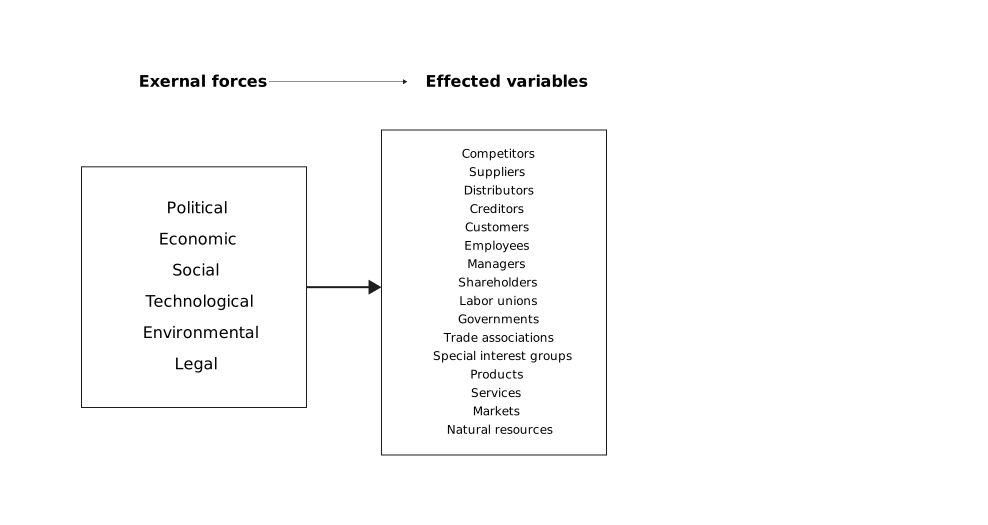
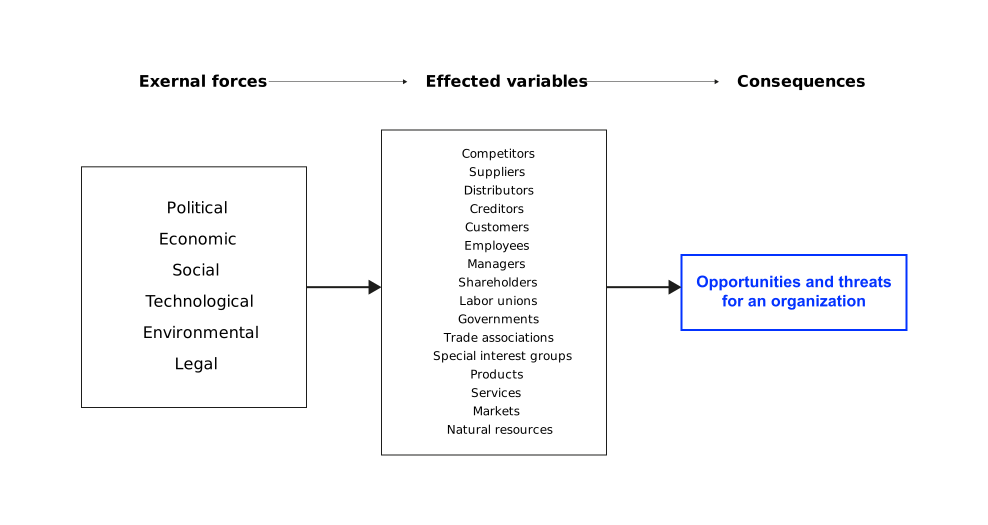
Scanning the environment to identify key variables so that strategies can be formulated to take advantage of the opportunities and reduce the impacts of the threats.
PESTEL Framework
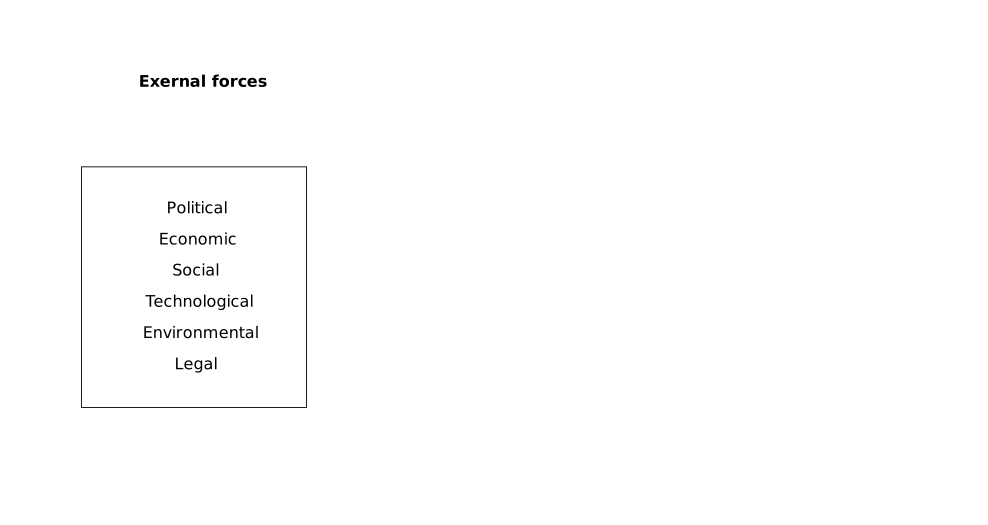
External forces can be systematically analyzed using the PESTEL framework (David & David, 2016):
Political, economic, social, technological, environmental, and legal forces.
Visualization
Porter’s Five-Forces Model
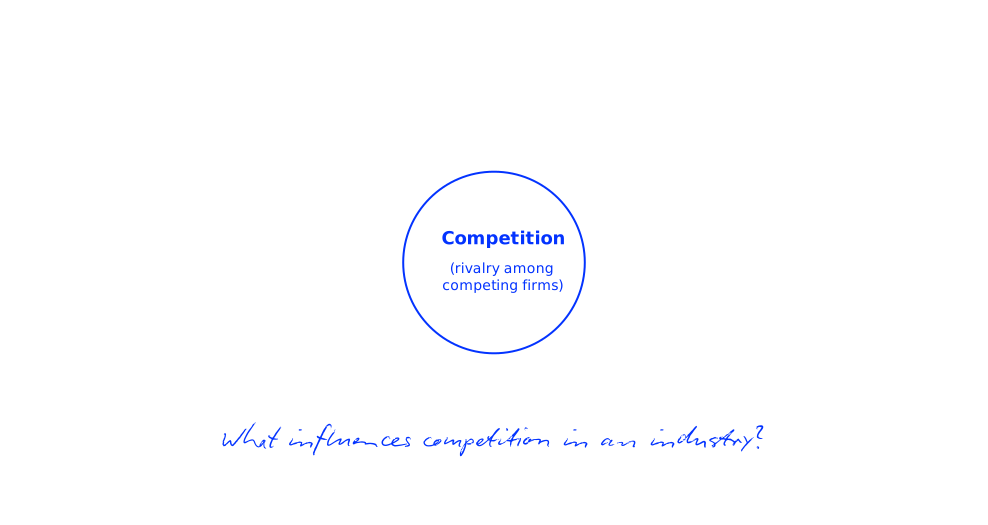
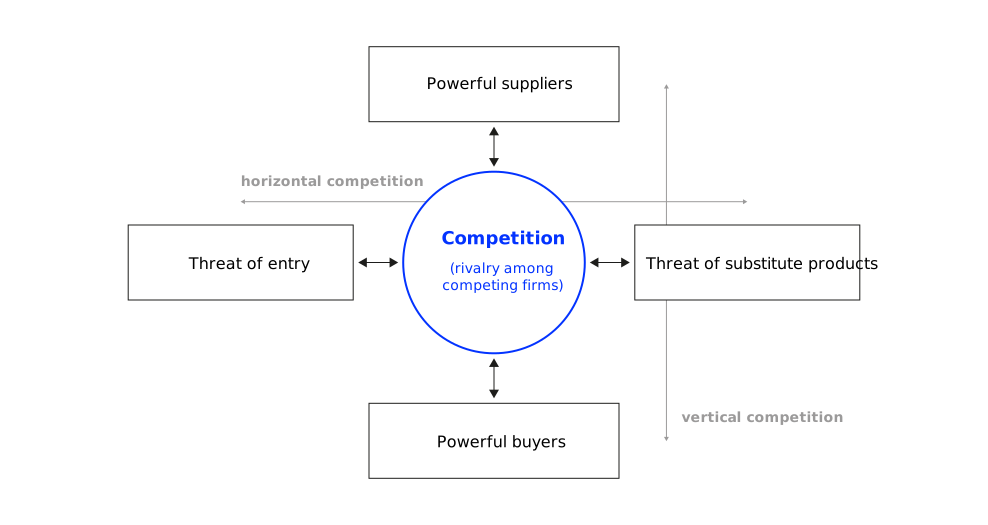
The essence of strategy is coping with competition.
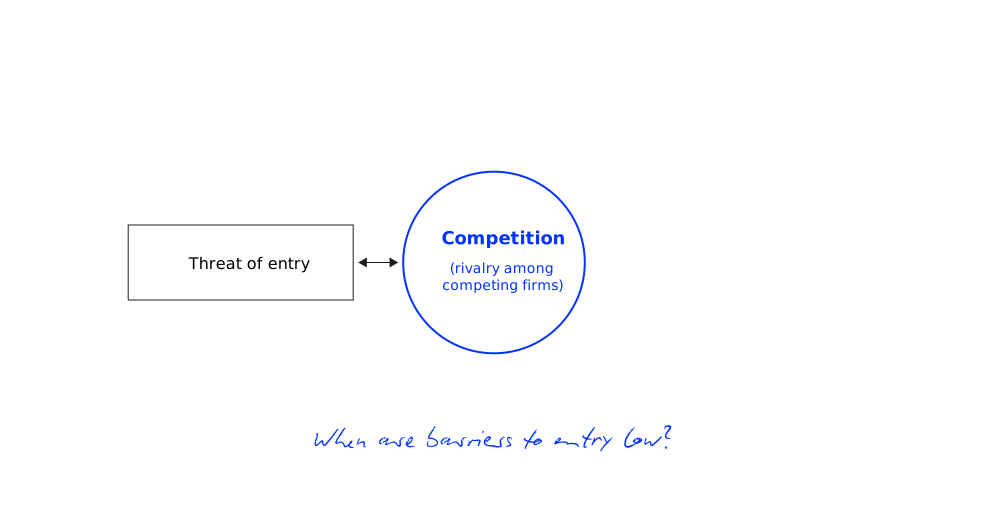
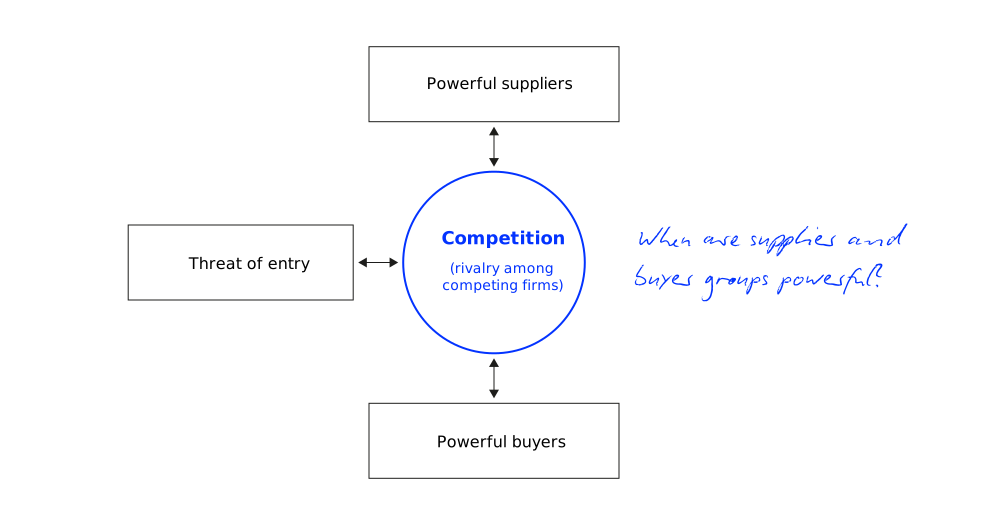
PESTEL forces influence the competitive landscape by shaping competitive forces. Porter proposes to (also) analyze these thoroughly.
Porter’s five forces is a framework to guide the analysis of competitive forces at play in a specific industry that determine its ultimate profit potential.
Visualization
Exercise
Have a look at the GenAI industry1
Apply Porter’s Five Forces model:
- Individual work (5 min): For each force, identify the top factor that makes it STRONG (increases competitive pressure) or WEAK (decreases competitive pressure).
- Row discussion (10 min): Share insights with students in your row. Identify the most significant factor per force. Locate the force in the PESTEL framework.
- Synthesis (5 min): For the one or two forces you flagged as STRONG, identify which value-stick lever it squeezes (willingness to pay, pricing strategy, cost management, or willingness to sell). Based on your analysis, is the GenAI industry attractive for profitability? Why or why not?
20:00
Megatrends
Long-term, global trends
that bring about fundamental changes and transformations
in various domains
and at multiple levels.
Examples
The Zukunftsinstitut identifies 12 long-term, transformative forces that impact all aspects of society, economy, and individual lives:
Globalisation, urbanization, silver society, health
new work, knowledge culture, connectivity,
mobility, neo-ecology, individualization, gender-shift,
and security.
Positioning
Porter’s Generic Strategies
To gain competitive advantage, organizations
can pursue three generic strategies:
Cost Leadership: becoming lowest-cost producer
Differentiation: unique products with distinct value
Focus: targeting specific market segment or niche
Ansoff’s Growth Matrix
The Ansoff matrix provides four growth strategies based on existing or new products and markets:
Market penetration: existing products, existing markets
Market development: existing products, new markets
Product development: new products, existing markets
Diversification: new products, new markets
Blue Ocean Strategy
Create and capture value without intense competition by identifying uncontested market spaces through value innovation (i.e., avoid competition).
Organizations should consider four key questions:
- Can we eliminate factors well below industry standard]
- Can we reduce factors well below industry standard]
- Can we raise factors well above industry standard]
- Can we create factors industry never offered]
Exercise
Pick one of the GenAI players from the Five Forces exercise, e.g., OpenAI, the company you assigned a school of strategy to in last week’s homework.
- Individual work (3 min): Classify the company’s current position using one framework from today: a generic strategy or an Ansoff quadrant.
- Pair discussion (7 min): Explain to your partner how the company arrived at that position. Does it read as the outcome of formal analysis (the Positioning school), a deliberate top-down plan (the Design or Planning school), or a pattern that only became a position in hindsight (the Learning school)?
- Synthesis (5 min): Connect your answer to Mintzberg’s 5 Ps: which of plan, pattern, or perspective produced this position?
15:00
Trade-Offs
Trade-offs are necessary to secure strategic position against activities that are incompatible.
The essence of strategy is choosing what not to do as much as choosing what to do.
Two-Way Door Decisions
Some decisions are consequential and irreversible or nearly irreversible —one-way doors— and these decisions must be made methodically, carefully, slowly, with great deliberation and consultation. If you walk through and don’t like what you see on the other side, you can’t get back to where you were before. We can call these Type 1 decisions. But most decisions aren’t like that —they are changeable, reversible— they’re two-way doors. If you’ve made a suboptimal Type 2 decision, you don’t have to live with the consequences for that long. You can reopen the door and go back through. Type 2 decisions can and should be made quickly by high judgment individuals or small groups. Jeff Bezos, 2015 Letter to the shareholders
Excursus: Climate Change
Group Exercise
Form groups of 3-4 students. Based on Hallegatte (2009), prepare a 5-minute presentation addressing the following:
- Importance of climate change for business
- Key challenges in climate decision-making
- Strategies for robust decision-making
- General implications for strategic management
Time allocation:
- 3 min: Individual reading review and note-taking
- 10 min: Group discussion and key point identification
- 7 min: Slide preparation
20:00
Key Takeaways
- External audit provides systematic approach to identifying opportunities and threats in the environment
- Five external forces (economic, SCDE, political/legal, technological, competitive) must be analyzed for strategic relevance
- Megatrends shape long-term strategic context and create both opportunities and threats over 10-20+ year periods
- Porter’s Five Forces help understand industry structure and competitive dynamics affecting profit potential
- Generic strategies offer frameworks for finding effective positions in the marketg and achieving competitive advantage (e.g., Porter’s generic strategies, Ansoff matrix, blue ocean strategy)
- Trade-offs are essential: strategy is as much about choosing what not to do as choosing what to do
- Climate change represents critical strategic factor requiring robust decision-making under uncertainty
Review and Consolidation
The following questions are designed to review and consolidate what you have learned and are a good starting point for preparing for the exam.
- Describe the nature and purpose of an external assessment in formulating strategies.
- What is Porter’s Five-Forces Model and what is its relevance in formulating strategies?
- What are (legal) key sources of information for identifying opportunities and threats?
- Why is [a megatrend] considered as a megatrend? Justify your answer.
- How have external factors resulted in a major overhaul to the traditional retail industry as we once knew it?
- Describe how political elections can be an important external factor for companies to consider. Select an industry and reveal some key political factors impacting firms.
- Explain how Facebook, Twitter, and Instagram can represent a major threat or opportunity for a company in different industries.
- Discuss the following statement: Major opportunities and threats usually result from an interaction among key environmental trends rather than from a single external event or factor.
- Do you agree with Porter’s view that competitive positioning within an industry is a key determinant of competitive advantage(s)?
- Explain the effects of [a generic strategy] on the value stick framework.
- Why do anual reports often state external risk information in really vague terms; why should strategists avoid including such vagueness in external assessments (e.g., in developing an EFE Matrix)?
Homework
Read Peteraf (1993) and make notes on following:
- Define the Resource-Based View (RBV): how does it differ from other strategy perspectives?
- Identify key resource types (tangible, intangible, human) and give examples from the paper.
- Explain resource heterogeneity: why is it central to competitive advantage in RBV?
- Explain resource immobility: how does it support sustained advantage?
- Define dynamic capabilities: how do they enable adaptation and innovation?
- Link resources to value creation: how do they drive advantage for customers?
- Explain performance differences: why do some firms consistently outperform others?
- Derive implications for strategy: how should firms apply RBV to compete effectively?
Q&A
Literature
Footnotes
GenAI industry refers to the industry concerned with developing large foundation models for e.g., text, image and video generation; main players are Antrophic, OpenAI, SpaceX, Google, Meta, and, maybe, Mistral).